About Doxocopa pavon (Latreille, 1809)
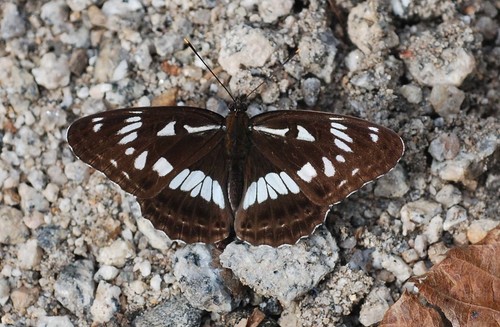
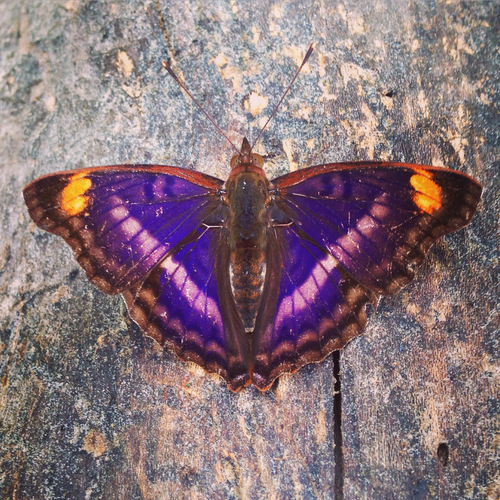
Doxocopa pavon, the species described here, has a wingspan ranging from 5.6 to 6.9 cm, equal to 2.2 to 2.7 inches. This butterfly is sexually dimorphic, meaning males and females have distinct appearance. Both sexes have a small orange patch located on the tips of their forewings. On the upper wing surfaces of males, the base color is predominantly brown, and it is covered with bright, iridescent bluish-purple. A faint, barely visible white band runs across the middle of the upper surfaces of both the forewings and hindwings. The undersides of the wings are plain pale brown, and also hold the small orange patch at the forewing tip. Females also have predominantly brown upper wing surfaces, but they lack the iridescent purple coloration seen in males. Like males, they have a white band across the middle of the upper surfaces of both forewings and hindwings. Unlike the faint male band, this female band is very distinct and broad, and it never reaches the front edge of the forewings. Doxocopa pavon closely resembles the related species Doxocopa laure (silver emperor), but can be told apart by several key traits. D. laure has a silvery sheen covering its wing undersides, while D. pavon has plain pale brown undersides. Both sexes of D. pavon lack the pointed hindwing tips that are present on D. laure. Male D. laure also have squarish-tipped extended forewings and a much larger orange forewing patch than male D. pavon. Female D. pavon also closely resemble both sexes of multiple species in the unrelated Adelpha genus, commonly called sisters. This includes the band-celled sister Adelpha fessonia, pointed sister Adelpha iphiclus, Celerio sister Adelpha serpa, Bredow's sister Adelpha bredowii, Arizona sister Adelpha eulalia, and California sister Adelpha californica. D. pavon can be distinguished from A. fessonia because the white band of D. pavon never reaches the front edge of the forewing. For A. bredowii, A. californica, and A. eulalia, their white bands are broken into separate spots along the front edge of the forewing, which is not the case for D. pavon. Adelpha and Doxocopa are thought to form a large mimicry complex, because some Adelpha species are unpalatable to predators. This species ranges from Bolivia and Paraguay in South America north to northern Mexico in North America. It can occasionally also be found in the lower Rio Grande Valley of Texas, United States. The subspecies D. p. theodora has a smaller restricted range, found only in Mexico, Central America, and the Caribbean. Doxocopa pavon generally inhabits tropical and subtropical forests, including rainforests, at elevations between roughly 200 and 1,000 meters, or 660 to 3,280 feet, above sea level. The larvae of D. pavon are green, with yellow-white dots running along their sides, and an indistinct row of yellow-white blotches across their upper body. The body tapers sharply to a pointed tail. The larval head is green, with black eyes and black mandibles. Two black-and-white stripes on the front of the head extend up into two long, forward-facing horns. The horns are green, with a forked black tip. D. pavon larvae feed on the leaves of hackberry trees in the genus Celtis. In the United States, larvae most often use desert hackberry Celtis pallida, while in Mexico they commonly feed on iguana hackberry Celtis iguanaea. The chrysalis of D. pavon is camouflaged to look like a leaf, matching the chrysalis shape and color of other species in the same butterfly subfamily. It is greenish, strongly arched, flattened from side to side, and has ridges running along its abdomen. Adult D. pavon feed on flower nectar, including nectar from plants in the genera Cordia (bocotes) and Croton (rushfoils). Adults are commonly found in sunlit forest areas, where they engage in mud-puddling on moist soil or rock that is rich in minerals. They will also feed on rotting fruit, carrion, and bird droppings. Males are encountered far more often than females, because they regularly perch on trees in full sunlight, especially at midday, while waiting for mates. Females are rarely seen, as they spend most of their time in the forest canopy.