About Dorymyrmex bureni
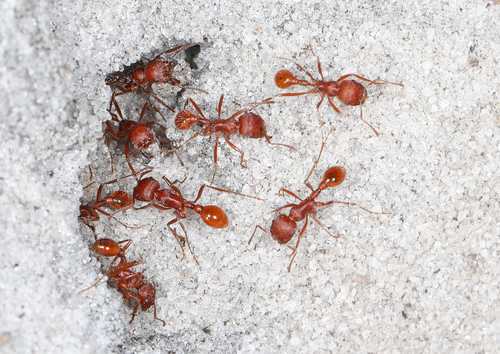
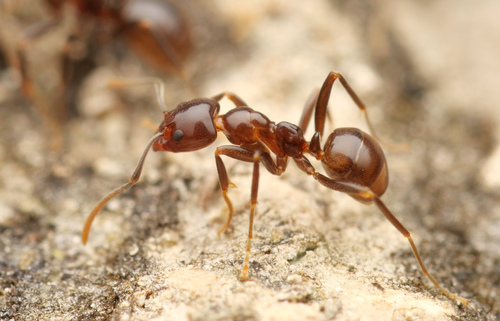
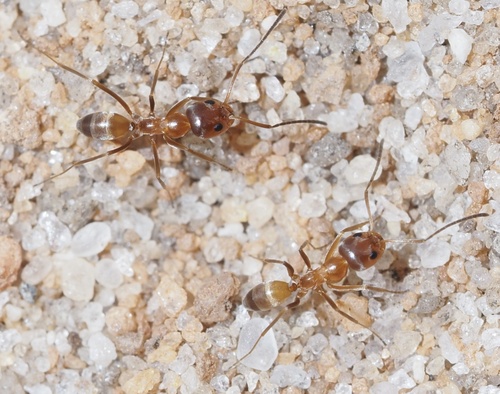
Dorymyrmex bureni, commonly called Buren's pyramid ant, is a species of ant in the genus Dorymyrmex. It was first described by Trager in 1988, and is endemic to the United States, with an introduced population on the manmade island of Ocean Cay in the Bahamas. Pyramid ants including this species are medium-sized, reaching 2–4 mm in length. Dorymyrmex bureni individuals are light orange in color and move quickly. Unlike many other local ant species such as the red imported fire ant (Solenopsis invicta), this species is relatively harmless to humans and cannot sting. When crushed, its workers release a foul, coconut-like odor. Dorymyrmex bureni hunts living insects, including other winged ants. It also forages to collect honeydew from sap-sucking insects. Curved hairs on the heads of these ants are used to carry beads of damp sand. Colonies of this species are small. Nests typically have one entrance, with a crater-shaped mound of sand built around it, and Dorymyrmex bureni prefers to live in sandy soil. This species is not an indoor pest, so pesticide use to control it is not necessary. Dorymyrmex bureni is found across the southeastern United States. It is almost entirely restricted to the Atlantic Coastal Plain, with populations reaching just outside the coastal plain in Alabama and Georgia. Its range extends continuously along the American east coast, from the Florida Keys north to coastal New Jersey. There is disagreement in scientific literature over the westernmost extent of D. bureni populations: some sources list the range as reaching Mississippi, while others state it extends to eastern Texas. Modern verifiable records of the species end around the Mississippi River. This disagreement over the species' western range limit is likely caused by the similar species Dorymyrmex flavus, whose distribution borders or overlaps directly to the west of D. bureni's range.