About Dorymyrmex bicolor Wheeler, 1906
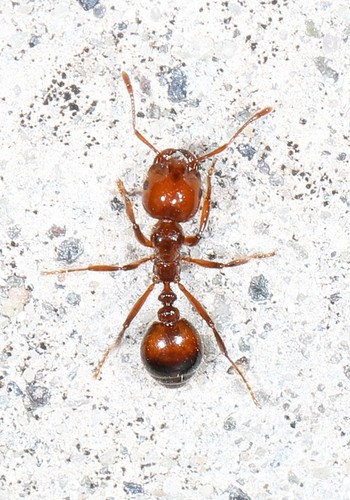
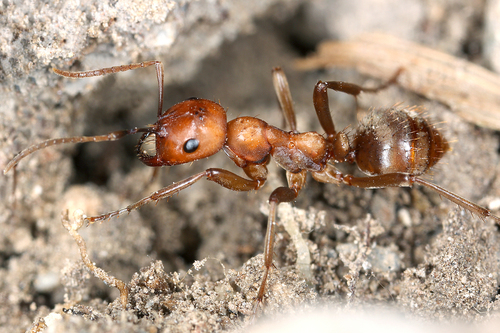
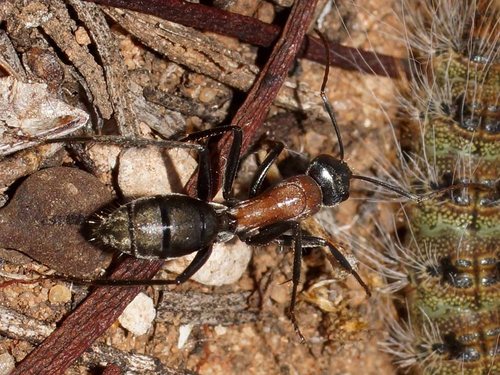
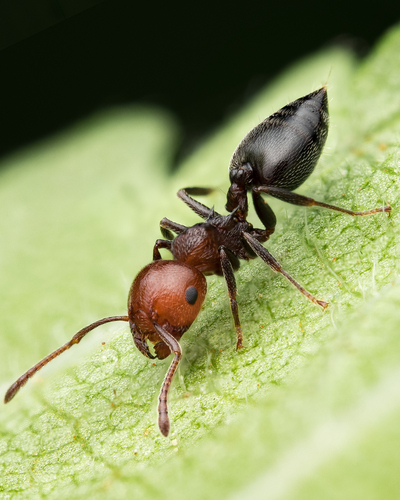
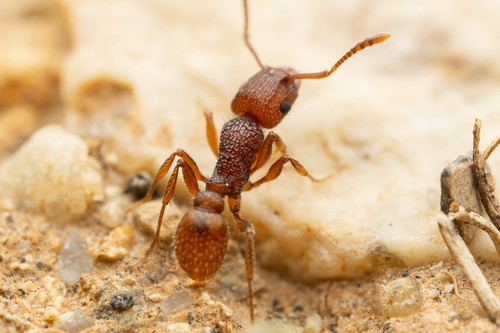
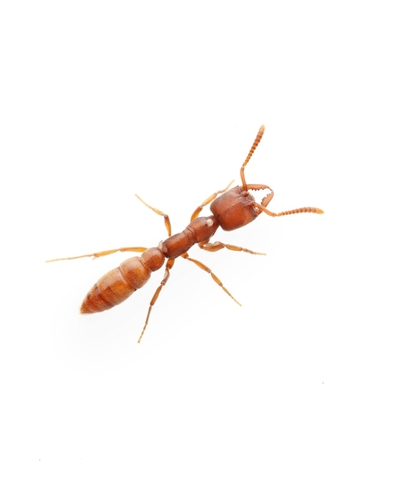
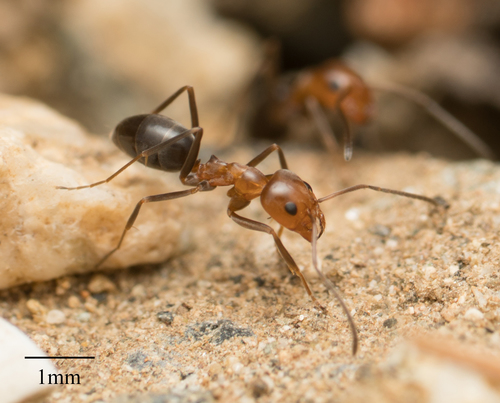
Dorymyrmex bicolor Wheeler, 1906 is an ant species in the Dolichoderinae subfamily. It is commonly called the bicolored pyramid ant, a name that refers to its two-toned body color and the shape of its mounds. This species was recently known under the name Conomyrma bicolor before being renamed Dorymyrmex bicolor. It has a single petiole, and a slit-like orifice that releases chemical compounds. This species of ant cannot sting. It primarily inhabits arid desert regions. Its known distribution range covers the southwestern United States (including the states of California, Texas, Arizona, New Mexico, and Oklahoma), northern and southern Mexico (including Baja California), El Salvador, Guatemala, Belize, Honduras, Peru, and several Caribbean island nations such as Jamaica.
This ant regularly interacts with three different species of ants from the genus Myrmecocystus. In the southwestern United States, Dorymyrmex bicolor and Myrmecocystus ants have large overlap in their use of space and food sources. Myrmecocystus ants repel other ants by secreting a substance from their poison gland onto discovered food sources. Dorymyrmex bicolor uses a distinct type of interference behavior against Myrmecocystus: worker ants of Dorymyrmex bicolor surround the entrance of a Myrmecocystus nest, and drop stones and other objects down the entrance to block it. Between 10 and 30 Dorymyrmex bicolor workers have been observed dropping stones into an opposing nest, but only 5 workers are needed to drop stones and other small objects at a rate efficient enough to impact the Myrmecocystus nest. Higher numbers of Dorymyrmex bicolor workers in an area reduces the number of Myrmecocystus workers in that area, sometimes resulting in drastic reductions.