About Dorstenia contrajerva L.
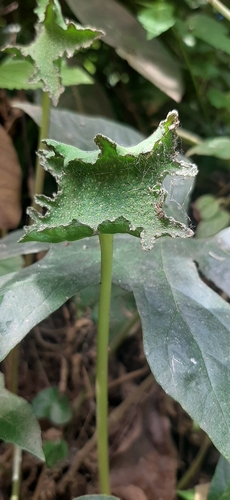
Dorstenia contrajerva L. is a small evergreen acaulescent or nearly acaulescent perennial plant that grows from a creeping rhizome. If stems are present, they are very short and covered with persistent petiole bases. A rosette of leaves with long petioles emerges from the rhizome; leaves are often very numerous and crowded. Both lobed and unlobed leaves can co-occur within the same populations. Leaves can be up to 20 cm long, with petioles ranging 8–25 cm in length. Leaf blades are long-petiolate, and can be oblong-ovate, deltate-ovate, or orbiculate; they are either entire, or deeply pinnately or almost palmately lobed, measuring 6–20 cm long by 7–22 cm wide. Lobes are acute to acuminate, and can be narrow or broad. Leaf surfaces are sparsely scabrous or pubescent. Stipules are persistent. The plant exudes white latex when damaged. Tiny male and female flowers are intermixed on a convoluted, discoid inflorescence receptacle. The receptacle is flat, curved, or undulate, quadrangular or irregularly lobed, it grows larger with age reaching 2–5 cm wide, and is scaberulous on its underside. The receptacle sits atop a long, slender peduncle 7–25 cm long. Small fruits are held within a quadrangular container, and the tiny seeds are explosively expelled. Fruits are somewhat globose drupes 0.25–1 cm in diameter; seeds are yellowish. The chromosome count for this species is 2n = 30. The 1927 United States Pharmacopoeia and National Formulary describes the rhizome (called contrayera) as fusiform, 1–2 headed, 5–7.5 cm long, 12 mm thick, reddish, with an unpleasant odor and an acrid, bitter taste. Dorstenia contrajerva is native to southern Mexico, Central America, the Caribbean, and northern South America including Peru. It is cultivated in Indonesia (Java), Malaysia (Malacca), and grown locally in parts of Africa and South America. It has been introduced to Florida in North America, where it grows as a weed in greenhouses and nurseries, and is sometimes cultivated as a house plant. It grows in shady locations in disturbed vegetation within mangroves, savannahs, thickets, and tropical forests. For cultivation, Dorstenia contrajerva requires part to full shade, and rich soil that should be kept moist but not saturated. It should be fertilized weekly with a balanced fertilizer diluted to half the recommended strength. If old receptacles are not removed, the species can become extremely weedy: its seeds are highly viable and germinate readily in any soil. Repotting can be done at any time of year. It is easily propagated from seed or by division; fresh seed will germinate in 7 to 14 days. This species has a long history of use in traditional medicine across the Americas. In Honduran folk medicine, boiled root is used to treat diarrhea, dysentery, and stomach ache; slightly roasted and ground root is used to treat intestinal worms and parasites; crushed root mixed with water is used to treat snake bites. In Nicaragua, boiled root is used to prevent diarrhea, while minced raw rhizomes treat diarrhea, sickness, stomach upset, indigestion, and worms. In El Salvador, it is used to treat stomachache and prevent vomiting. In Costa Rica, boiled root is used for diarrhea, and an infusion of the root is used to lower fever; the plant is also considered useful for diarrhea and as an emmenagogue. In Mexico, the plant’s latex is used to heal wounds, and inflorescences are given to teething children. In the Peruvian Amazon, it is used as a tonic, to treat gangrene, and as an antidote for bee and wasp stings. In Argentina, the whole plant is used to treat snakebite. In Venezuela, it is used as a sudorific and a cure for dysentery. Duke's Handbook of Medicinal Plants of Latin America lists the following medicinal activities for the plant: alexiteric, anti-HIV, diaphoretic, diuretic, emmenagogue, febrifuge, leishmanicide, orexigenic, stimulant, and tonic. The 1927 United States Pharmacopoeia and National Formulary notes the root was used for low fevers, typhoid, diarrhea, dysentery, and serpent bites, prepared as a decoction or tincture. In her 1931 work Modern Herbal, Maud Grieve wrote that contrayerva, prepared as a powder or decoction, acts as a stimulant, tonic, and diaphoretic, and is used in cases of low fevers, typhoid, dysentery, diarrhea, and other illnesses requiring a stimulant. It has long been used in folk medicine to treat bites from poisonous animals. The first description of this plant and its medical use in Mexico was recorded by Spanish naturalist and physician Francisco Hernández de Toledo in the 16th century. In his account, the plant is called Tozpàtli, it produces a round root around the size of a hazelnut, with thin fibrous roots and an azure color, from which grow delicate petioles carrying curved leaves almost similar to those of Polypodium, but smaller and greener. It was reported to not produce any flower, and grows in high, flat, hot places. The root is sharp and fragrant to taste, hot and dry almost in the fourth degree, with subtle parts. This herb cures rashes/eruptions (empeynes), boils, whitlow, and the so-called French illness (syphilis), and clears up tumors and abscesses. The root, when applied externally or taken by mouth, alleviates many diseases that can be easily understood from the described qualities and properties. Hernandez concluded that this is an important and noteworthy plant, that local apothecaries could not do without. The 1728 Chambers Cyclopedia entry for “Contra-yerva” notes that root brought from Peru is considered an alexiterial and a sovereign antidote against poison. It also states the root and the preparation Lapis Contrayerva are highly effective for smallpox, measles, fevers, and all cases that require diaphoresis or increased perspiration. 18th–19th century Spanish-Mexican physician and botanist Vicente Cervantes described the plant as having an aromatic smell, an acrid, somewhat bitter and persistent taste. He recorded its virtues as stimulating, tonic, and diaphoretic, and recommended it for putrid or adynamic fevers. In North America, there is one reported other use: powder made from the rootstocks and leaves is mixed with tobacco to improve the taste of cigarettes.