About Donatia novae-zelandiae Hook.fil.
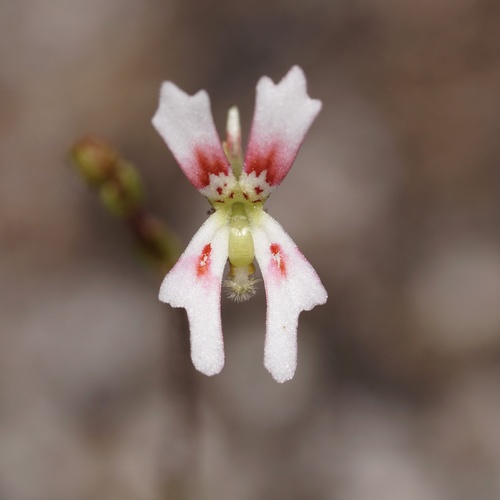
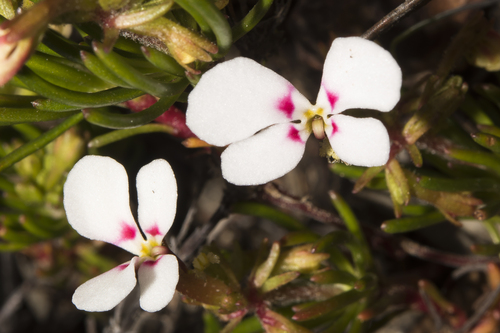
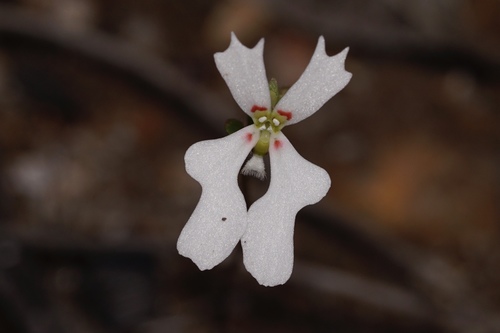
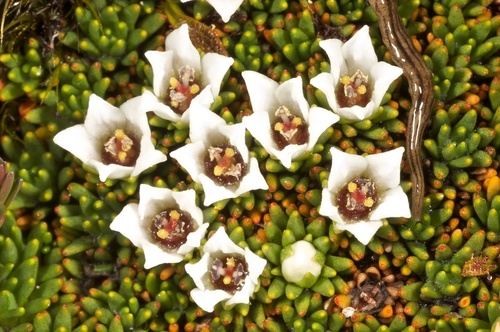
Donatia novae-zelandiae Hook.fil. is a perennial mat-forming plant that can grow to over one meter in diameter. Its mat is constructed from densely packed tufts, each tipped with imbricated leaf spirals, all connected to a single root system. Its leaves are sessile with widened bases, measure 5 to 6 millimeters long, and grow erect. Upper leaves are bright green, while older lower leaves are brown and persist on the plant for a long time. Dense tufts of white hairs 2 to 3 millimeters long grow in the leaf axils. Stomata are visible on both leaf surfaces, running parallel to the leaf's main axis, with each stoma's guard cells surrounded by a distinctive circular ridge. Flowers are white, 5 to 6 millimeters wide, and grow solitary, scattered across the surface of the mat. Each flower has 5 triangular sepals, 2 stamens, and 5 pointed oblong petals that are 5 millimeters long. Flowering takes place from January to March. Fruits are turbinate in shape, and fruiting occurs from February to March. Regarding distribution and ecology, the species is thought to have originated in Tasmania during the Pliocene and Pleistocene eras, when major mountain ranges formed across Australia and New Zealand. These geologic changes led to glaciation and cooling temperatures that created the modern alpine and sub-alpine environments the species inhabits. A long-distance dispersal event, likely facilitated by Antarctica, brought Donatia novae-zelandiae and other Stylidiaceae species to New Zealand, where the species was already pre-adapted to grow in alpine and sub-alpine habitats. Donatia novae-zelandiae is most common in cushion moorland, which typically develops in high-rainfall, poorly drained areas located above 800 meters elevation. Waterlogging, peat substrate, and harsh environmental conditions prevent tree growth, so these areas are completely dominated by cushion plants. Donatia novae-zelandiae can occur as solitary mats, or as part of a mosaic alongside other cushion plants and micro shrubbery. The dense interlocking tufts that characterize cushion plants help the group survive strong winds and resist freezing temperatures. In mixed cushion plant mosaics, cushion species are generally known to support other species by providing this protective environment. However, a 2012 study led by Brittany Cranston found that Donatia novae-zelandiae is a poor facilitator of other species. When Donatia novae-zelandiae was introduced to an open alpine area, the site's species richness decreased. This contrasts with another cushion species, Silene acaulis, which was found to increase species richness in the same conditions. The study also found that removing neighboring plants from around Donatia novae-zelandiae caused significant heat stress for the species. Researchers concluded that facilitative effects vary widely between different cushion plant species. Donatia novae-zelandiae appears to be more adapted to thrive through competition for space in moorland, gaining more benefit from its neighboring plants than it provides to them. Unlike some other cushion species, it does not grow on and stabilize skeletal substrates. Cushion plants can also act as ecosystem engineers along natural waterways in moorland, where they grow upward to form dam-like walls that block water flow. This process creates a series of stepped ponds dammed by cushion plants including Donatia novae-zelandiae, which promotes further cushion growth in a positive feedback system.