About Dolomedes triton (Walckenaer, 1837)
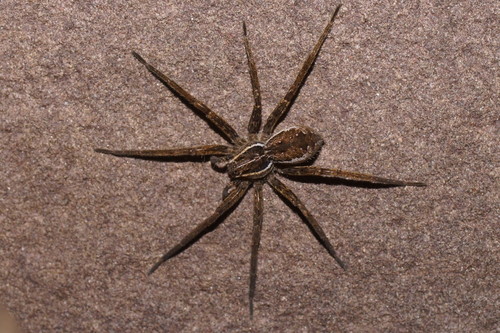
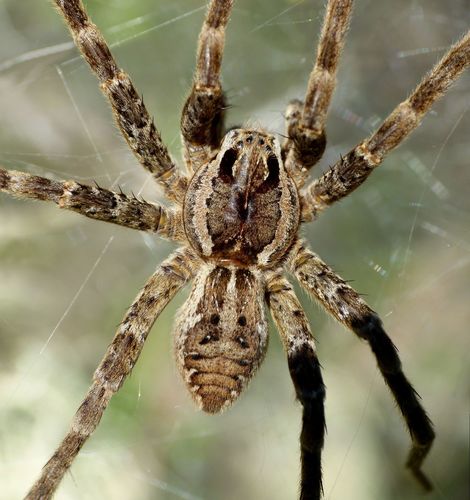
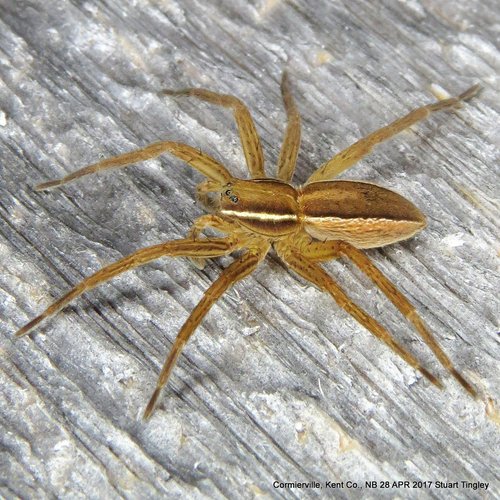
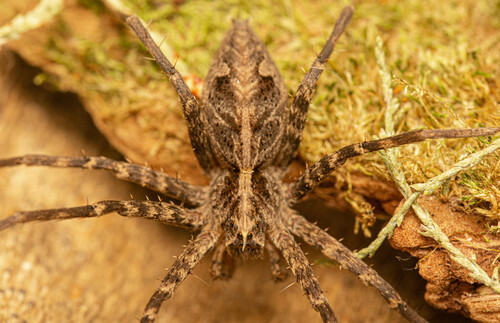
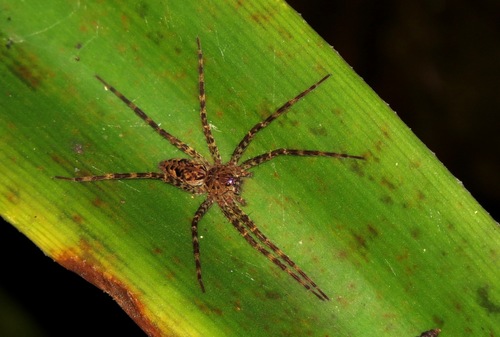
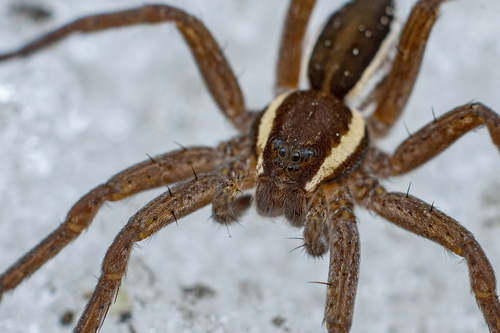
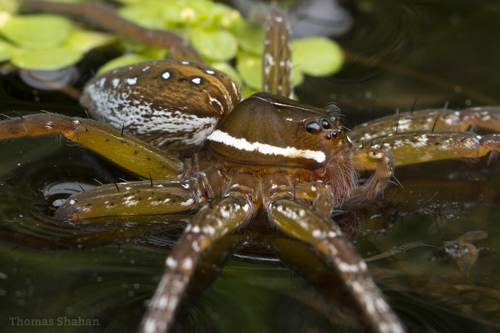
Dolomedes triton (Walckenaer, 1837) can be identified by its large size and distinctive markings. It has eight eyes that provide good vision, and its body ranges in color from grey to brown. A white to pale cream-colored stripe runs down each side of its cephalothorax. The abdomen bears many light-colored spots, and also has light-colored lines running along its sides. When viewed from below, six dark spots are present on the underside of the cephalothorax, which gives this species its common name. Like many spider species, Dolomedes triton shows sexual dimorphism, with females growing larger than males. Females reach a total length of around 60 millimeters (2.4 in) including legs, with a body length of 15–20 mm (0.59–0.79 in); males have a body length of 9–13 mm (0.35–0.51 in). Juvenile spiders look similar to adults but are smaller, and grow through a series of molts over their lifetime to reach adult size. While somewhat visually similar to Dolomedes striatus, this species is distinguished by its unique pattern of three pairs of dark sternal spots and several light spots on the abdominal dorsum. Males have a more apically rounded tibial apophysis that extends past the apex of the tibia. In females, the seminal valve of the copulatory apparatus is located in the anterior half of the dorsal epigynous area, with loose fertilization tubes. This species is known to be remarkably variable in both appearance and behavior across its geographic range. Dolomedes triton is native to the Western Hemisphere, and occurs throughout the contiguous United States and southern Canada. It is more common east of the Rocky Mountains and Great Plains, and has been reported from Ontario, Maine, southern Florida, Texas, west to the southern panhandle of Alaska, and south to the Yucatan Peninsula and Chiapas, Mexico. It is not commonly collected in southwestern U.S. states. This is a semi-aquatic species that lives in wetland habitats including ponds, lake shores, and slow-moving streams. It inhabits the littoral zones of lakes and ponds, as well as slow-moving pools and edge zones of streams. It can be found among emergent vegetation, rocks, and other structures near water such as boat docks. Around 10–14 days after mating, female D. triton produce egg sacs that they carry in their mouths. Egg production can occur any time between June and September, and occasionally, though not often, in April. Before the eggs hatch, the female builds a "nursery web" over vegetation and guards it. The egg sac is placed among leaves to help keep it concealed. After the offspring hatch, they remain under the female's protection in the web until they are ready to disperse. Offspring leave the nursery web about one week after hatching. Females defend their egg sacs intensely; the egg sacs are so strongly attached to the mouthparts that removing them causes the sacs to rupture. When boldness was measured as the amount of time spent on the water's surface rather than submerged, with more surface time counted as bolder, females were bolder during periods of parental care and spent more time above water. This trend, while initially surprising, may reflect the energetic costs of staying underwater with an egg sac, or developmental harm if eggs remain underwater for extended periods. Both food availability and female size have significant effects on reproductive output. Field observations show that clutch size, egg sac weight, and body size all decrease when food availability is limited. This pattern is especially pronounced in larger females, which indicates that smaller females may have a selective advantage in less resource-rich ponds, while larger females perform better in areas with high food availability. Because cannibalism had no effect on female fecundity or egg sac weight, researchers conclude that cannibalism provides no significant nutritional benefit to female D. triton.