About Dolomedes plantarius (Clerck, 1757)
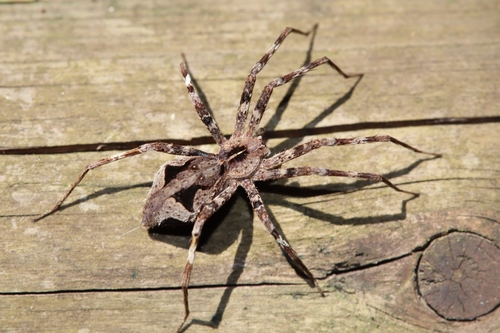
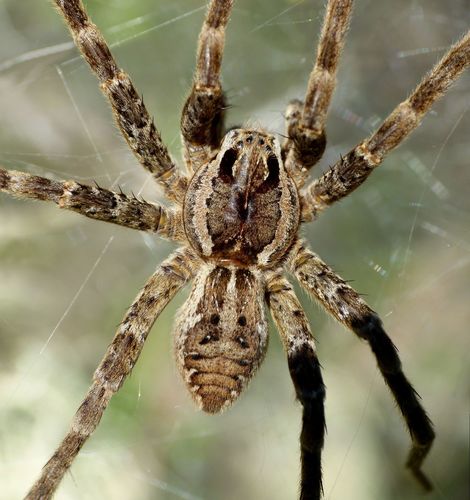
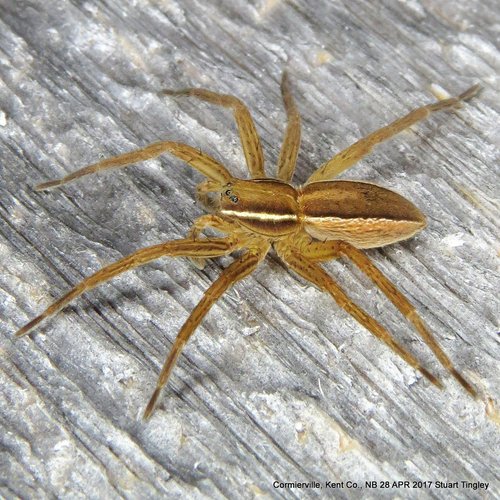
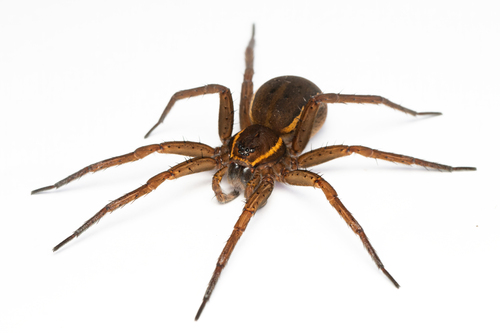
Dolomedes plantarius, commonly known as the great raft spider, is a large spider species across its range. Adult females have a body length that can measure just over 20mm, with a total leg span reaching 70mm. Its body is typically black or brown, with white or cream-colored stripes running along the sides. It looks extremely similar to its close relative the raft spider Dolomedes fimbriatus, and the two are often misidentified. Like most other species in the Dolomedes genus, the great raft spider is semi-aquatic. It lives in lowland fen and grazing marsh habitats, and relies on the presence of standing or slow-moving water that is neutral to alkaline. Within these habitats, it occurs along the margins of pools and ditches. Emergent vegetation is critical to this species: it uses the plants as perches for hunting and basking, and as support for its nursery webs. As a warmth-loving species, it avoids areas where water surfaces are shaded. Populations of the great raft spider are distributed across Europe and Russia, and have been recorded specifically in Austria, Belarus, Belgium, Bulgaria, the Czech Republic, Denmark, Estonia, Finland, France, Georgia (country), Germany, Hungary, Italy, Latvia, Lithuania, Norway, the Netherlands, Poland, Romania, Serbia, Slovakia, Sweden, Switzerland, and the United Kingdom. In the United Kingdom, an outlying population was first discovered at Redgrave and Lopham Fen in 1956 by arachnologist Eric Duffey. Two more populations were later identified: one at the Pevensey Levels in East Sussex by Peter Kirby in 1988, and another near Swansea, South Wales, by Mike Clark in 2003. The species was also recorded at Sound Heath in Cheshire in the 1960s. The lack of historical records makes it very difficult to estimate how much this species has declined, or to explain the widely separated pattern of its current distribution in the UK. Water is required for all stages of the great raft spider's life cycle. This spider has a total lifespan of two and a half years. Juveniles hibernate through the winter, and reach sexual maturity during their final spring. In the UK, adult females usually have two breeding attempts between July and September. The spiders use their chaetae sensory system to find mates, and courtship occurs on the water surface. Males approach females slowly and carefully, while tapping the water surface with their legs. Once close to the female, males perform slow bobbing movements of their body. If the male is accepted, mating is brief and completed within seconds. Females lay several hundred eggs inside a silk egg sac, which measures about 10mm across. Females carry this sac under their bodies for approximately three weeks. During this period, they periodically dip the sac into water to keep the eggs from drying out. The female also finds a suitable nest site in emergent vegetation, typically between 10 and 100 cm above the water surface. Shortly before the eggs hatch, she builds a tent-shaped nursery web. She guards the young spiderlings inside this web until they disperse into the surrounding area, which usually happens five to nine days after hatching. If a female produces a second brood later in the summer, the brood is usually smaller and less likely to be successful. Courtship and mating generally happen early in the breeding season. Adult males die shortly after mating, and almost all are dead by late July. Females survive until the end of the summer.