About Dolomedes dondalei Vink & Dupérré, 2010
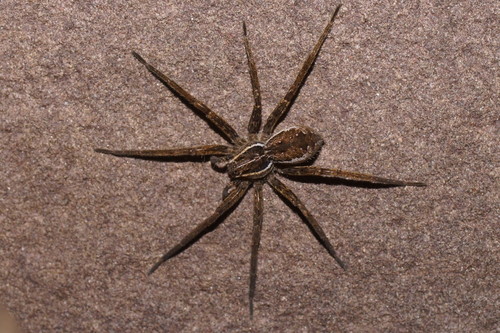
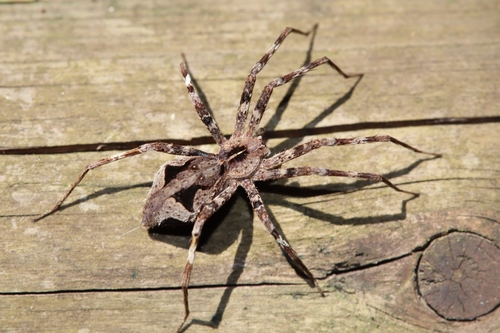
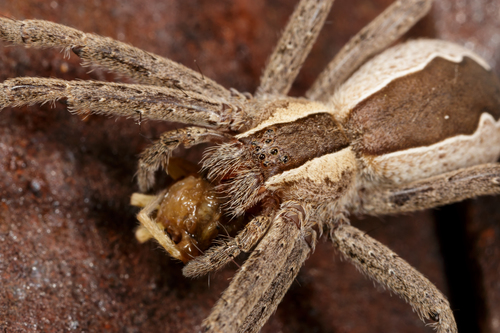
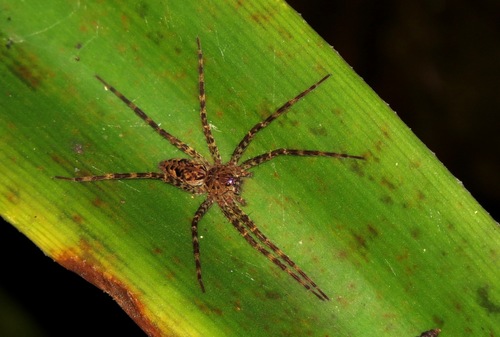
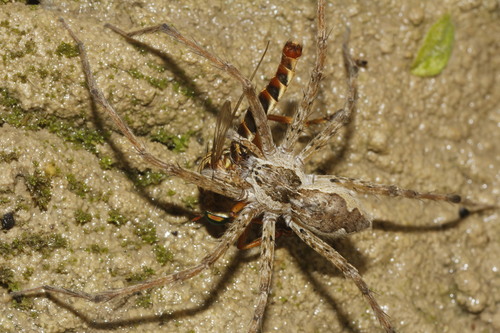
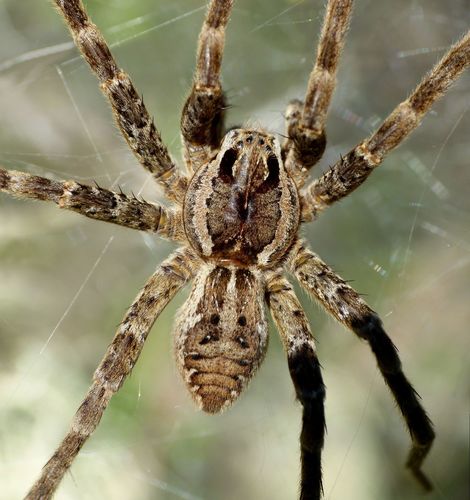
Dolomedes dondalei is one of four Dolomedes spider species found in New Zealand. Including its legs, this species can grow up to 7 cm across. Males have a body length of 12–18 mm, while females have a body length of 18–25 mm. Its cephalothorax is dark orange-brown with yellow stripes running down it; by comparison, the related species D. aquaticus has a grey cephalothorax. While the species has distinct features in male pedipalps and female genitalia, it can be easily told apart from other Dolomedes species by stripes along each side of its abdomen: these stripes are light yellow-brown, with several patches that extend a short distance toward the abdomen's midline. These spiders weigh less than one gram and are covered in hydrophobic hairs, which allows them to walk on the surface of water without sinking. D. dondalei is endemic to New Zealand, and occurs throughout both the North and South Islands. Unlike its close relative D. aquaticus, which lives on open riverbeds and lake shores, D. dondalei prefers shaded waterways surrounded by native forest or dense vegetation. It lives under rocks located close to rivers, and adults are most commonly seen in December and January. D. dondalei is nocturnal, and is most active two hours after dusk. During the day it hides under stones and logs. At night, it hunts along the edge of water, either placing its legs on the water surface or anchoring itself to the shore with its back legs while the rest of its body floats. It detects prey vibrations using long sensory hairs on its legs, then moves out onto the water surface, resting on water surface tension, and can use a silk dragline to stop itself from overshooting its target. This hunting method allows it to catch insects and even small fish; in laboratory experiments, it was the only New Zealand Dolomedes species shown to be able to catch small fish. To escape predators, D. dondalei dives underwater and hides between stones. It can survive underwater for up to half an hour, using air trapped on the hairy surface of its body. D. dondalei is cannibalistic, and will opportunistically eat other spiders. Females sometimes eat smaller males after mating, and may even lure males to be eaten even if they have already mated. To avoid sexual cannibalism, males may potentially mate with newly moulted virgin females. Females carry their eggsac in their chelicerae, and build a nursery web between river stones or in vegetation beside streams. This species is attacked by two species of pompilid parasitic wasps, Cryptocheilus australis and Sphictostethus nitidus. These wasps paralyze D. dondalei spiders, and will sometimes pursue them underwater, then drag the spider back to a nest to feed the wasp's larva. The eggsacs of D. dondalei make up a large part of the diet of nestling fernbirds (Poodytes punctatus).