About Dolichoderus mariae Forel, 1885
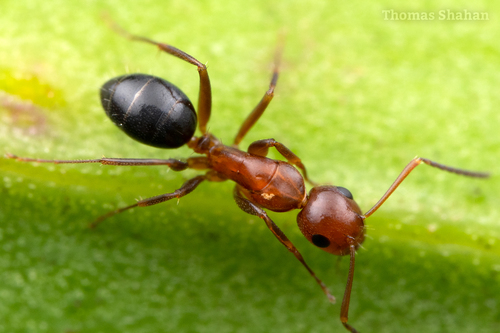
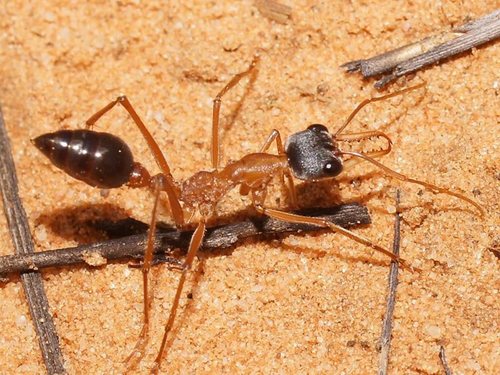
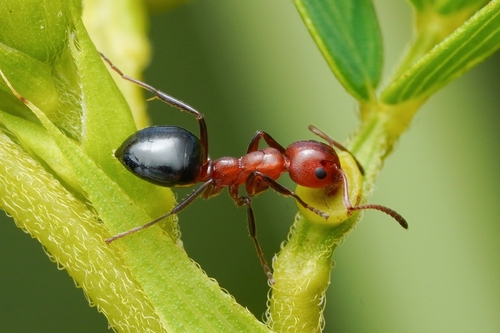
Dolichoderus mariae Forel, 1885 is an ant species with a distinctive color pattern: its head, antennae, thorax, legs, petiole, and the anterior portion of the first abdominal segment are reddish or ochre-brown, while the rest of the abdomen is black or deep brown. Its integument is smooth and shiny, though fine sculpturing granules are visible under magnification. The propodeum is longer than it is wide, concave on its posterior side, and marked with fine vertical striations. Both the head and body of this ant are hairless. This species has a wide distribution across the United States, covering Illinois, Minnesota, Oklahoma, North Carolina, South Carolina, Georgia, Mississippi, Louisiana, and northern Florida. Its type locality is Vineland, New Jersey. It is common in some regions like the Carolinas, but rare in others. In the southern part of its range, it can be confused with the similar species Dolichoderus pustulatus. D. mariae inhabits prairies, glades, and fens, and nests underground among plant roots. A study of this species conducted in northern Florida observed its nesting and colony behavior in detail. Worker ants remove soil from under clumps of wiregrass, other grasses, and fibrous-rooted plants including Rubus spp. (blackberry) and Typha spp. (cattails). Each individual nest is a single large conical chamber that opens to the air around the base of the host plant. Colonies consist of multiple such nests connected by above-ground ant trails that ants use to travel between nests. Each nest holds multiple queens. Over winter, a colony typically maintains only one or two nests. As summer progresses, workers excavate more new chambers, and a colony can reach up to sixty nests by late summer. After late summer, the number of nests begins to contract again. Colonies occupy roughly the same area each summer, and territorial aggression has been observed between neighboring colonies. Within their territory, ants tend and milk aphids and scale insects to collect their honeydew, and also scavenge for dead insects. The overall size of a colony and the number of its nests depends on the abundance of hemipterans within the colony’s territory. When hemipterans are abundant over winter, a colony contracts much less than it does during harsh seasons. Observations inside nests show that workers, queens, alates, and brood position themselves on the fibrous roots that act as a natural scaffolding inside the nest chamber. Nest size corresponds to the size of the root system of the plant growing above the nest. During summer, workers at some nests chew plant material to build a papery felt-like thatch covering above the nest; researchers have not determined why this thatch is built for some nests but not others. In winter, the average nest holds around 75,000 workers and 12 to 59 queens. In summer, each nest contains 13,000 to 19,000 workers and approximately 180 queens. Alates first appear in April, with the majority present in July. Nuptial flights occur early in the morning after heavy rain; thousands of male alates take flight to seek other nests or colonies. Most female alates stay at their original nest, where they likely mate and join the existing group of queens. Abandoned D. mariae nests from winter provide shelter for vertebrates and invertebrates including snakes, lizards, and ground-dwelling spiders.