About Dodonaea viscosa (L.) Jacq.
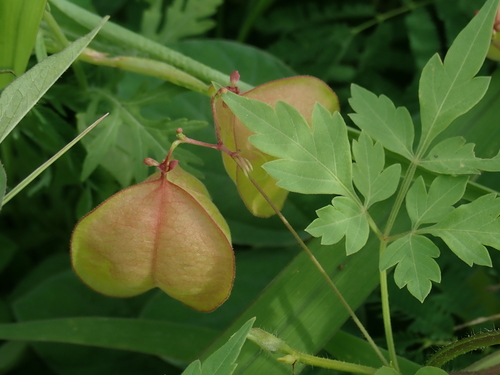
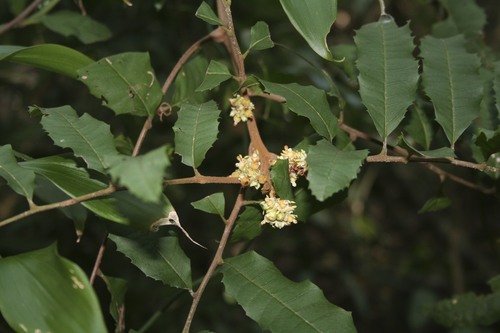
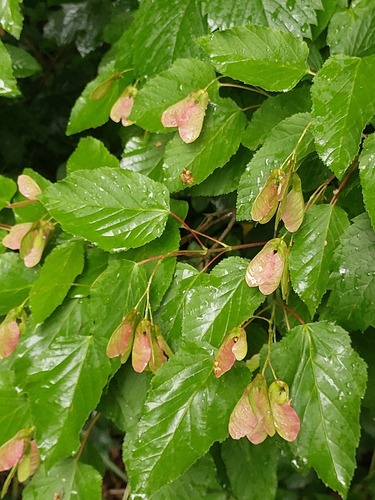
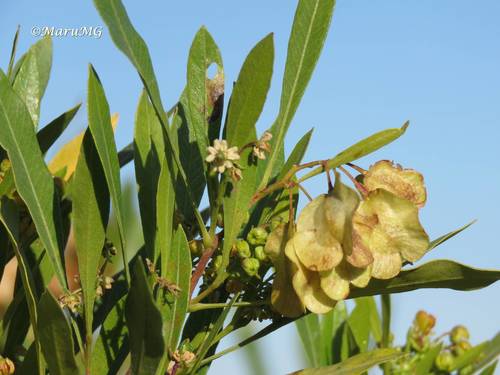
Dodonaea viscosa (L.) Jacq. is most often a shrub that grows 1–3 m (3.3–9.8 ft) tall, and rarely grows as a small tree reaching up to 9 m (30 ft) tall. Its leaves vary in shape: they are generally obovate, but some are lanceolate. They are often sessile, measure 4–7.5 cm (1.6–3.0 in) long and 1–1.5 cm (0.39–0.59 in) broad, are arranged alternately on the stem, and secrete a resinous substance. Many specimens have leaves with a pointed or rounded apex, an extended leaf base, and a leathery texture that is tough yet pliable. The leaf midrib is medium in prominence, becoming less visible near the apex. Secondary veins are thin and generally indistinct; there are usually 6 to 10 pairs, which may be opposite, subopposite, or alternate arranged in a camptodrome venation pattern. Venation branches off the midrib at angles ranging from 12° to 70°. In some plants, basal veins angle very steeply upward, with a divergence angle close to 45°. Basal secondary venation branches from a point near the base of the main midrib and runs parallel to the leaf margin, staying 1 to 2 millimeters away from the leaf edge. Leaf margins are usually toothed or undulating. The remaining secondary veins occur at regular intervals. Flowers usually grow at the ends of branches. The flowers range in color from yellow to orange-red, and are produced in panicles around 2.5 cm (0.98 in) long. Individual flowers are either male or female, and an individual plant usually bears only male or only female flowers, though plants occasionally bear flowers of both sexes. Pollen is dispersed by wind (anemophily), and it is thought that flowers lost petals over evolution to increase pollen exposure to the wind. The fruit is a capsule 1.5 cm (0.59 in) broad, that is red when immature and brown when ripe, with 2 to 4 wings. In ecology, Dodonaea viscosa is a widely distributed shrub found across tropical and subtropical regions worldwide. Its leaves secrete a white resinous substance with allelopathic effects. In coastal regions of Brazil, D. viscosa reduced the abundance of other native species to one-fifth of that found in open sites, and showed a strong negative interaction strength, indicating an interfering interaction pattern. The wood of D. viscosa is extremely tough and durable. In New Zealand, it is the heaviest native wood of any species, and Māori have traditionally used it to make weapons, carved walking staves, axe-handles, and weights for drill shafts. People in western New Guinea, Southeast Asia, West Africa and Brazil use D. viscosa for house building and as firewood. Its leaves may be used as plasters for wounds. Native Hawaiians made pou (house posts), laʻau melomelo (fishing lures), and ʻōʻō (digging sticks) from ʻaʻaliʻi (D. viscosa) wood, and a red dye from the plant's fruit. The cultivar 'Purpurea', which has purple foliage, is widely grown as a garden shrub. Dodonaea viscosa easily colonizes open areas and secondary forest, and is resistant to salinity, drought and pollution. It can be used for dune stabilization, remediation of polluted lands and for reforestation. The plant is tolerant of strong winds, so it is commonly used as a hedge, windbreak, and decorative shrub. The Seri people use the plant medicinally. In Africa and Asia, it has been used to stimulate lactation in nursing mothers, treat dysentery, cure digestive system disorders, treat skin problems and rheumatism. In New Guinea, people use it as incense for funerals. In the past, Australians used D. viscosa instead of hops for brewing beer, which is reflected in its common name "hopbush". For cultivation, Dodonaea viscosa can be grown from seeds, though pre-treatment of the seed in very hot water may be required. It can also be cultivated from cuttings; this method is sometimes used to produce female plants, whose winged fruits are valued for aesthetic purposes. Hopbush can survive long dry periods, and grows easily without heavy fertilization. Because it is sensitive to frost, it grows best in sheltered locations with well-drained, moist soil and full sun. It can grow in a variety of sites, but should not be planted in areas prone to fire, as it burns quite easily.