About Dodonaea lanceolata F.Muell.
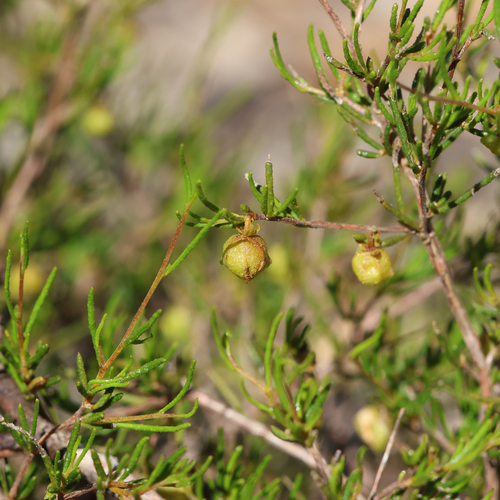
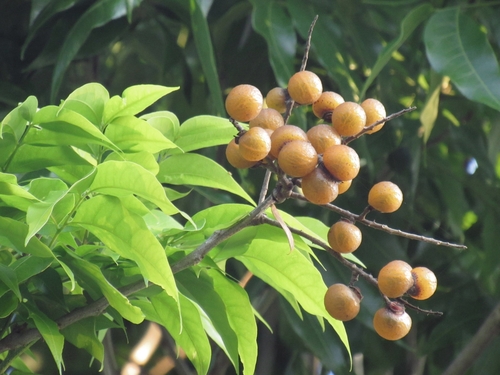
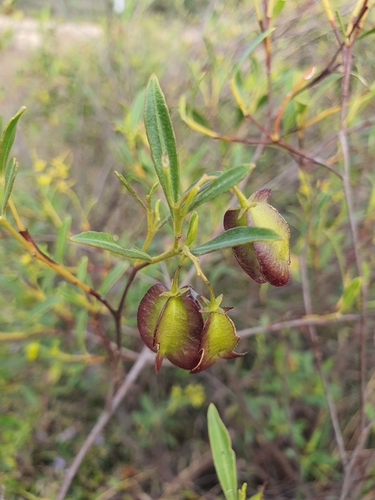
Dodonaea lanceolata F.Muell. is an erect shrub that is typically either dioecious or polygamous, and usually grows between 1 and 3 metres (3 feet 3 inches to 9 feet 10 inches) tall. This species has simple leaves that range in shape from elliptic to lance-shaped, sometimes with the narrower end at the base. The leaves measure 30 to 105 millimetres (1.2 to 4.1 inches) long and 10 to 30 millimetres (0.39 to 1.18 inches) wide. Leaves may be more or less sessile, or borne on a petiole that is 4.5 to 15 millimetres (0.18 to 0.59 inches) long. Flowers are arranged in panicles at the ends of branches. Each individual flower grows from a pedicel 5.5 to 12 millimetres (0.22 to 0.47 inches) long, and has four sepals that range from lance-shaped to egg-shaped, measuring 1.4 to 2.5 millimetres (0.055 to 0.098 inches) long. There are usually eight stamens, and the ovary is glabrous. Flowering takes place from February to October. The fruit is a three-winged capsule, 13 to 19 millimetres (0.51 to 0.75 inches) long and 14 to 19 millimetres (0.55 to 0.75 inches) wide, with membranous wings that are 4.5 to 5.5 millimetres (0.18 to 0.22 inches) wide. Dodonaea lanceolata (known as Pirrungu) occurs in northern and central Australia. The variety D. lanceolata var. lanceolata grows on stony ridges and near rocky watercourses in the Hamersley Range and Kimberley regions of Western Australia, in the Northern Territory, and in western Queensland. D. lanceolata var. subsessilifolia grows in open forest and is restricted to eastern Queensland.