About Dodecatheon pulchellum (Raf.) Merr.
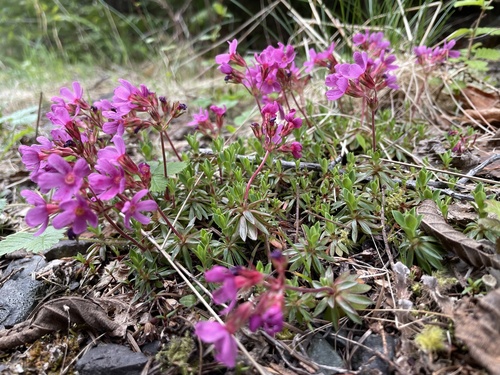
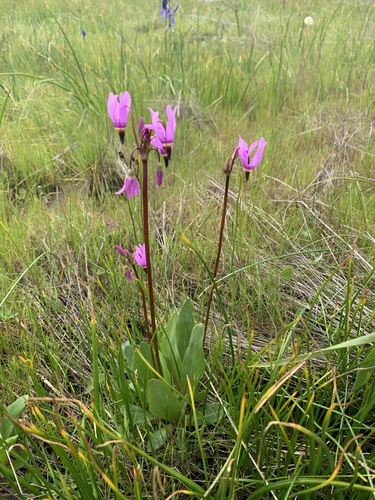
Primula pauciflora is a widespread, highly variable polyploid complex with chromosome counts of 2n = 44, 88 and 132. The species is generally hairless, with a flowering stem measuring 10–40 cm (4–16 in) tall. Its inflorescence holds between 2 and 15 flowers, which typically have magenta to lavender petals 9–14 mm (0.4–0.6 in) long. Primula pauciflora has been split into up to seven varieties, each with its own often complex set of synonyms. Primula pauciflora var. pauciflora, with the synonym Dodecatheon pulchellum, is a herbaceous perennial that grows single, leafless flower stems from very short erect root stocks that do not produce bulblets. It reaches a height of 5–40 cm (2.0–15.7 in). Its leaves grow in a basal cluster, are 2–15 cm long, with blades shaped oblong-lanceolate to oblanceolate, mostly smooth-edged to slightly small-toothed, and narrow gradually into winged stalks that are nearly as long as the blades. Each plant produces between 1 and 25 flowers clustered at the top of the stem. The calyx is usually purple-flecked, with five lobes 3 to 5 millimeters long. The corolla is 10 to 20 millimeters long, with five lobes curved sharply backward; the lobes are purplish-lavender, and rarely white, while the short corolla tube is yellowish, typically marked with a purplish wavy line at its base. The filaments are fused into a yellowish tube 1.5–3 mm long, which is smooth or only slightly wrinkled. The five anthers are connected to a projecting point, usually yellowish to reddish-purple, and 4–7 mm long. The stigma is slightly larger than the style. This plant flowers between April and August. Its fruits are many-seeded ovoid-cylindric capsules, hairless to glandular-hairy, with membranous to firm walls, 5–15 mm long, that open from the tip into sharp teeth. Under the name Dodecatheon pulchellum, this plant has received the Royal Horticultural Society's Award of Garden Merit. If it does not receive adequate moisture during the growing season, it will die back to the roots but will regrow the following year. In cultivation, it is hardy down to −15 °C (5 °F), and prefers a sheltered location in partial or full shade with neutral or acid soil, such as a woodland setting. While it needs moisture, the pretty shooting-star also requires good drainage, and does not grow well in boggy or riparian conditions. When grown in good conditions, the plant's crown will grow much larger and produce multiple blooming stems. Larger plants can be successfully divided for propagation in late fall.