About Dodecatheon meadia subsp. meadia
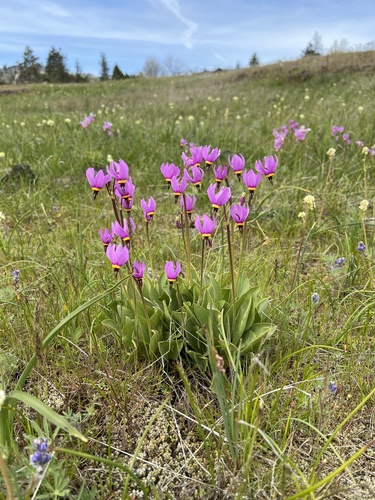
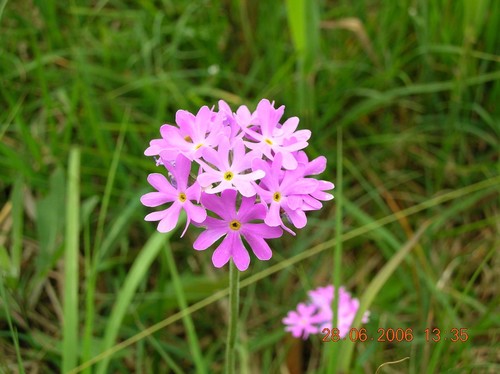
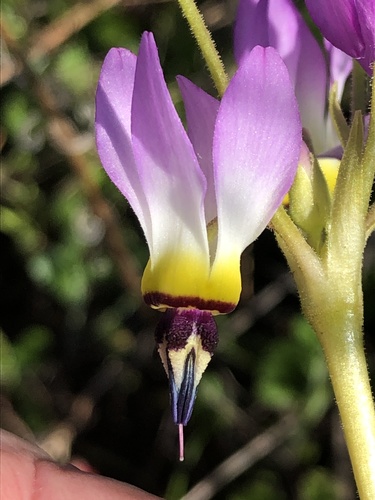
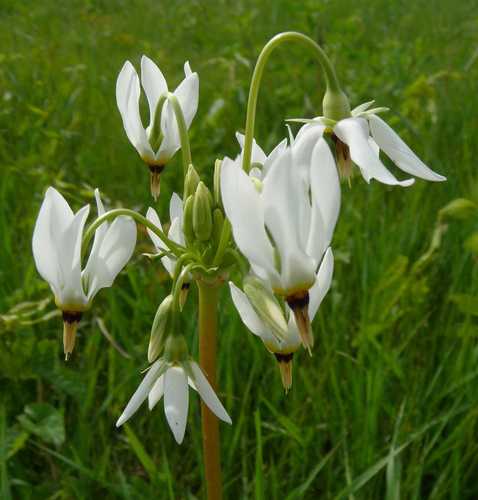
Primula meadia (also classified as Dodecatheon meadia subsp. meadia) is a perennial scapose plant, meaning its flowers grow from a basal leaf rosette. It reaches a height of 8–20 inches (203–508 mm). Its petals are reflexed, with a protruding column of anthers that form a central cone-like shape, giving the flower a shooting star appearance which inspires its common nickname. Most leaves are basal and lanceolate, growing up to 6 inches long and 2.5 inches wide. The leaves have smooth margins, a distinct central vein, and are emerald green, occasionally with a red base at the leaf. Flowers bloom in spring (March through spring) and the plant goes dormant by late summer. Fruits develop in early summer (May to June) before the plant enters its annual dormant phase. Flowers point sharply backward, arranged in a terminal umbel that holds 8 to 20 flowers per umbel. Seeds are dispersed when wind shakes the plant's erect scapes. This species is geographically widespread and shows notable morphological variation across its range. Most southern populations have white petals, while northern populations bear petals that range from white to pink, lavender, or magenta. Petals are fused at the base, and the base can vary in color, forming uneven rings in white, yellow, or maroon. The Dodecatheon genus, native to North America, includes over 12 species. Primula meadia is the most widespread species in this genus, found across central and eastern United States, ranging specifically from southern Wisconsin to western Pennsylvania, and south to southeastern Texas and Georgia. It grows in a broad range of natural habitats including both forests and prairies, and is most often found in calcareous areas. It can be locally common in parts of its range, but becomes rare at the edges of its geographic distribution. Primula meadia flowers are pollinated by bumble bees and other native bees. Honeybees do not act as pollinators for this species, because it produces only pollen and no nectar. Pollinators use a specialized method called buzz pollination, where they vibrate their wings and muscles near the flower's anthers to shake pollen loose. The anthers are adapted to this pollination strategy: they are poricidal, meaning they release pollen through small pores at the end instead of a typical split. The pollen capsules are 0.25 to 0.75 inches long and hold very small seeds that are later dispersed by wind. This pollination method ensures effective pollen transfer with little to no pollen waste. Primula meadia is commonly used as an ornamental plant for gardening. It grows well when unobstructed by other flowers, and is suited for placement near the front of flower beds. It can coexist successfully with other species in woodland gardens or rock gardens, and fits well alongside other native wildflowers. It grows best in partially shaded naturalized areas, and is non-invasive, naturalizing without becoming aggressive. It is not toxic to humans or pets, and is not preferred by deer. Both the typical Primula meadia and the white-flowered form P. meadia f. album have earned the Royal Horticultural Society's Award of Garden Merit. Primula meadia 'Goliath' is a cultivar that produces large flowers on taller scapes. This species grows well when surrounded by shorter plants during its early growing stages. While its ideal condition is partial shade, it can also grow in full sun in cooler zones as long as the soil stays moist. It prefers rocky, sandy soil, but can also thrive in clay soil. When propagated from seed, it grows very slowly, sometimes taking up to 4 years to produce its first bloom. The plant benefits from treatment with fire or brush removal, and can persist in open habitats when competition from woody vegetation is limited.