About Dodecatheon conjugens Greene
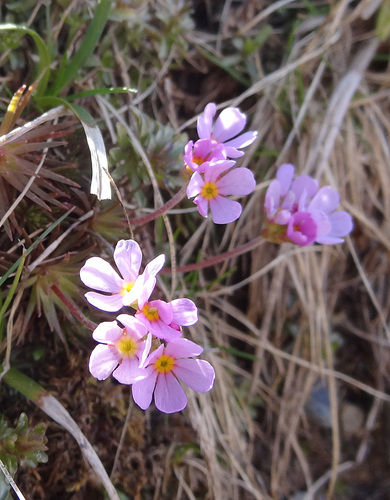
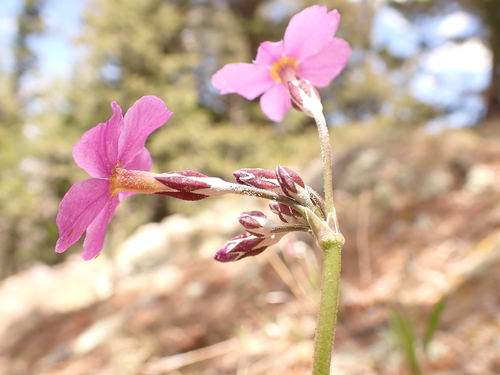
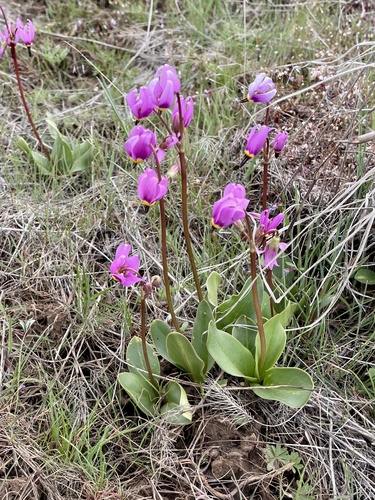
This species, currently classified as Primula conjugens (with the scientific synonym Dodecatheon conjugens Greene), is a thick-rooted perennial herb. It produces a basal rosette of narrow, oval-shaped leaves. Slim, tall dark-colored stems grow erect from the basal rosette, each topped with an inflorescence holding 1 to 7 showy flowers. Blooming occurs from April to July. When newly opened, each flower nods with its mouth pointed downward, and becomes more erect as it ages. The flower has five reflexed sepals, most often in shades of magenta, and rarely white, that lie back against the flower body. A ring of bright yellow sits at the base of the sepals. Large dark red or black anthers protrude from the mouth of the corolla, surrounding a threadlike pink stigma. The fruit produced by this plant is circumscissile. This plant is of special value to native bumble bee species. Historically, it was consumed by Native Americans, and it may still be suitable to prevent starvation. This perennial wildflower is native to western North America. Its range extends from northeastern California, the Great Basin, and the Pacific Northwest in the United States, east to Wyoming and Montana, and north across western Canada to Saskatchewan. It grows in seasonally wet locations across multiple habitat types, including sagebrush steppe, sagebrush scrub, yellow pine forest, wetland-riparian zones, and moist mountain slopes and meadows. It occurs at elevations between 200 and 1,900 metres (660 to 6,230 ft).