About Diuris unica D.L.Jones
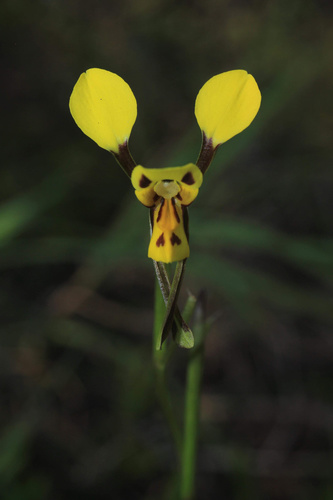
Diuris unica is a tuberous, perennial herb. It produces a single linear leaf that is 150–280 mm (6–10 in) long, 3–7 mm (0.1–0.3 in) wide, and folded lengthwise. A flowering stem 150–450 mm (6–20 in) tall bears up to eight flowers, each 18–25 mm (0.7–1 in) wide. The flowers are bright lemon-yellow, with a small number of dark markings at the base of the dorsal sepal and the labellum. The dorsal sepal curves upwards, has an egg shape, and measures 7–10 mm (0.3–0.4 in) long by 5–7 mm (0.2–0.3 in) wide. The lateral sepals range from egg-shaped to spatula-shaped, with their narrower end positioned toward the base; they are 8–18 mm (0.3–0.7 in) long, 2–3 mm (0.08–0.1 in) wide, held below the horizontal plane, and sit parallel to each other or crossed. The petals are erect, with an elliptical to nearly round blade that is 5–8 mm (0.2–0.3 in) long and wide, attached to a blackish stalk 4–5 mm (0.16–0.20 in) long. The labellum is 7–9 mm (0.3–0.4 in) long and has three lobes. The central lobe is egg-shaped to wedge-shaped, 6–8 mm (0.2–0.3 in) long and 5–8 mm (0.2–0.3 in) wide. The side lobes are oblong to broadly wedge-shaped, 3–4 mm (0.1–0.2 in) long and about 2 mm (0.08 in) wide. Two thick, ridge-like calli 4–5 mm (0.16–0.20 in) long run along the mid-line of the base of the labellum. Flowering takes place from July to September. This orchid grows in wallum and sandy heath habitats in coastal and near-coastal districts of south-eastern Queensland, with a disjunct population in northern New South Wales.