About Diuris tricolor Fitzg.
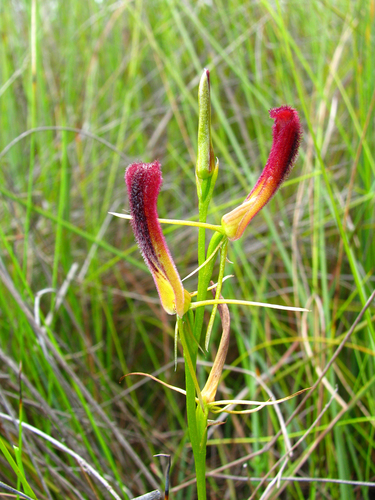
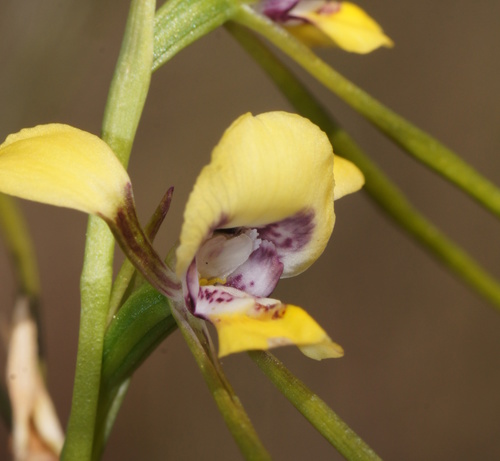
Diuris tricolor (long-tailed donkey orchid), described by Fitzg., is a tuberous, perennial herb. It grows up to three linear leaves that are 200–300 mm (8–10 in) long, 3–4 mm (0.1–0.2 in) wide, and folded lengthwise. Between two and six orange to yellow flowers with white and purplish tints are borne on a 200–400 mm (8–20 in) tall flowering stem, and each flower is 25–30 mm (0.98–1.2 in) wide. The upward-curving dorsal sepal is 10–15 mm (0.4–0.6 in) long, 6–9 mm (0.2–0.4 in) wide, and broadly egg-shaped. The lateral sepals are narrow linear, 20–65 mm (0.8–3 in) long, much less than 1 mm (0.04 in) wide, and turned downwards. The petals are more or less erect or turned backwards, and are egg-shaped to elliptic; the petal blade is 10–16 mm (0.4–0.6 in) long and 6–10 mm (0.2–0.4 in) wide, borne on a reddish purple stalk 3–7 mm (0.1–0.3 in) long. The labellum is 8–12 mm (0.3–0.5 in) long and has three lobes. The centre lobe is egg-shaped, 6–9 mm (0.2–0.4 in) long and wide, with a central ridge. The side lobes are 3–4.5 mm (0.1–0.2 in) long and about 2 mm (0.08 in) wide. Two callus ridges about 4 mm (0.2 in) long are located near the mid-line of the labellum. Flowering occurs from September to November. Long-tailed donkey orchid grows in grassland and forest in south-east Queensland, and grows sporadically south from Deepwater in New South Wales, and in the Australian Capital Territory. A single specimen has been recorded in Victoria, just south of the New South Wales border.