About Diuris sulphurea R.Br.
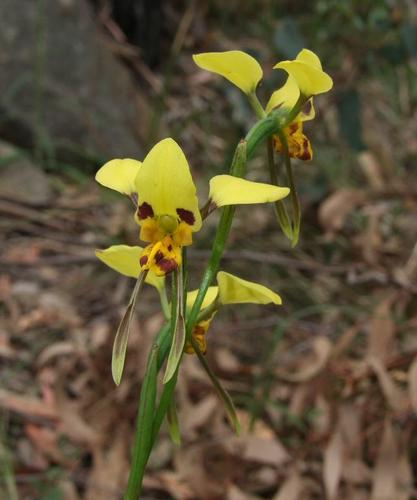
Diuris sulphurea R.Br. is a tuberous perennial herb. It grows up to three linear to lance-shaped leaves, each 200 to 500 millimetres (8 to 20 inches) long and 3 to 4 millimetres (0.1 to 0.2 inches) wide. Up to seven flowers, each 20 to 30 millimetres (0.8 to 1 inch) wide, are borne on a flowering stem 200 to 500 millimetres (8 to 20 inches) tall. The flowers are bright yellow with a few prominent dark brown markings. The dorsal sepal is egg-shaped, erect or leaning forward, 15 to 20 millimetres (0.6 to 0.8 inches) long and 9 to 13 millimetres (0.4 to 0.5 inches) wide. The lateral sepals are green or green and brown, linear, 16 to 25 millimetres (0.6 to 1 inch) long, 1 to 3 millimetres (0.04 to 0.1 inches) wide, turned downwards and usually parallel to each other. The petals are erect or turned backwards, with an egg-shaped blade 12 to 18 millimetres (0.5 to 0.7 inches) long and 7 to 11 millimetres (0.3 to 0.4 inches) wide, growing on a dark brown stalk 5 to 8 millimetres (0.2 to 0.3 inches) long. The labellum is 10 to 15 millimetres (0.4 to 0.6 inches) long and has three lobes. The centre lobe is spade-shaped, 8 to 13 millimetres (0.3 to 0.5 inches) long and 7 to 10 millimetres (0.3 to 0.4 inches) wide. The side lobes are egg-shaped with the narrower end towards the base, 4 to 6 millimetres (0.16 to 0.24 inches) long and 2.5 to 4 millimetres (0.1 to 0.2 inches) wide. A ridge-shaped callus runs along the mid-line of the labellum base, extending about halfway along the labellum. Flowering occurs from August to December. Common name tiger orchid, this species occurs in all Australian states except Western Australia and the Northern Territory. It grows in forest, woodland, heath, grassland and coastal scrub. In Victoria, it often grows alongside Diuris pardina and sometimes forms hybrids with this species.