About Diuris setacea R.Br.
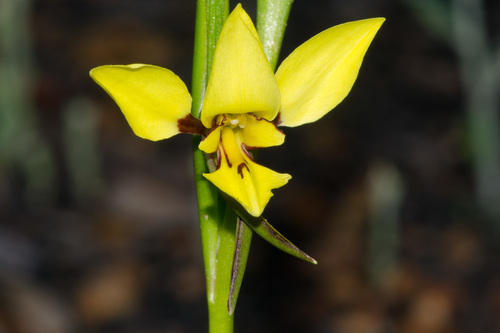
Diuris setacea R.Br., commonly called the bristly donkey orchid, is a tuberous perennial herb. It has a tuft of six to ten spirally twisted leaves at its base; each leaf measures 50–100 mm (2–4 in) long and 1–2 mm (0.04–0.08 in) wide. Between two and seven yellow flowers with brown markings are borne on a flowering stem 150–300 mm (6–10 in) tall. Each flower is 25–30 mm (0.98–1.2 in) long and 20–30 mm (0.8–1 in) wide. The dorsal sepal is erect, 13–16 mm (0.5–0.6 in) long and 7–8 mm (0.28–0.31 in) wide. The lateral sepals are 15–18 mm (0.6–0.7 in) long, 2–3 mm (0.08–0.1 in) wide, and curved downwards. The petals are roughly erect or bent backwards, 11–14 mm (0.4–0.6 in) long and 6–7 mm (0.24–0.28 in) wide, growing from a greenish brown stalk 3–5 mm (0.12–0.20 in) long. The labellum is 12–14 mm (0.47–0.55 in) long and has three lobes. The central lobe is diamond-shaped, 6–8 mm (0.2–0.3 in) wide, and folded along its length. The side lobes are 4–6 mm (0.16–0.24 in) long and 4 mm (0.2 in) wide, and spread away from each other. Two ridge-like calli, 5–7 mm (0.2–0.3 in) long and outlined in brown, run along the mid-line of the labellum. Flowering takes place from October to December, and is far more prolific after fire occurs in the previous summer. This orchid grows in low heath in moist soil on granite outcrops between Esperance and Kalbarri.