About Diuris punctata Sm.
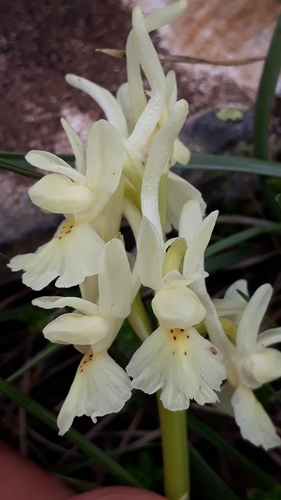
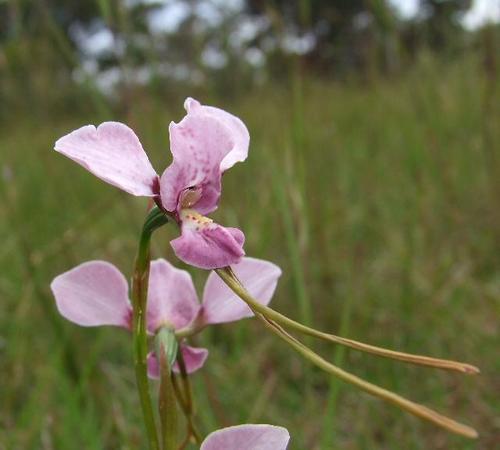
Diuris punctata Sm., commonly called the purple donkey orchid, is a tuberous perennial herb. It has two linear leaves that are 150–300 mm (6–10 in) long, 3–4 mm (0.1–0.2 in) wide, and folded lengthwise. Between one and ten flowers, each 50–60 mm (2.0–2.4 in) wide, are borne on a flowering stem that reaches 300–600 mm (10–20 in) in height. The flowers are purple or mauve, often marked with darker markings, and sometimes with yellow markings. The dorsal sepal is roughly erect, elliptic to egg-shaped, 10–18 mm (0.4–0.7 in) long and 8–14 mm (0.3–0.6 in) wide. The lateral sepals are greenish-brown, linear to lance-shaped, 30–50 mm (1–2 in) long, 2–4 mm (0.08–0.2 in) wide, and curved downwards. The petals are erect, bearing an egg-shaped blade 7–17 mm (0.3–0.7 in) long and 7–15 mm (0.3–0.6 in) wide, attached to a dark coloured stalk 2–6 mm (0.08–0.2 in) long. The labellum is 9–15 mm (0.4–0.6 in) long and has three lobes. The centre lobe is broadly egg-shaped to fan-shaped, 7–12 mm (0.3–0.5 in) long and 12–20 mm (0.5–0.8 in) wide. The side lobes are linear to wedge-shaped, 3–5 mm (0.1–0.2 in) long and 1.5–4 mm (0.06–0.2 in) wide. Two ridge-like calli around 5 mm (0.2 in) long, surrounded by yellow, sit along the mid-line of the labellum. Flowering occurs from September to December. This orchid is distributed across New South Wales, the Australian Capital Territory and Victoria, where it grows in forest and grassland habitats. In New South Wales, it occurs south from the Moonbi Range, and in Victoria it occurs north from the Mornington Peninsula. A variety called Diuris punctata var. sulfurea was recorded from a property near Guyra; it bore smaller, yellow flowers, and is now thought to be extinct.