About Diuris pardina Lindl.
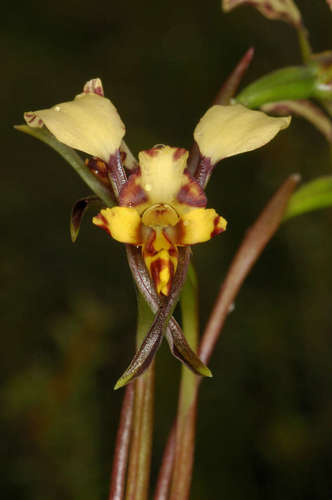
Diuris pardina Lindl. is a tuberous perennial herb. It grows two or three linear leaves that are 100–300 mm (4–10 in) long, 4–6 mm (0.2–0.2 in) wide, and folded lengthwise. Between two and ten flowers, each 20–35 mm (0.8–1 in) wide, are borne on a flowering stem 140–300 mm (6–10 in) tall. The flowers are yellow, heavily marked with large dark reddish-brown blotches. The dorsal sepal stands erect, is 8–11 mm (0.3–0.4 in) long and 6–8 mm (0.2–0.3 in) wide. The lateral sepals are linear to lance-shaped, 14–16 mm (0.55–0.63 in) long and 2–3 mm (0.08–0.1 in) wide, and point downwards, usually strongly crossed over each other. The petals are either erect or curved backwards, each with an egg-shaped blade 9–12 mm (0.4–0.5 in) long and 6–8 mm (0.2–0.3 in) wide, attached to a reddish-brown stalk 4–7 mm (0.2–0.3 in) long. The labellum is 9–12 mm (0.4–0.5 in) long and divided into three lobes. The central lobe is wedge-shaped, 7–9 mm (0.3–0.4 in) long and wide, while the side lobes are oval, 4–6 mm (0.16–0.24 in) long and about 2 mm (0.08 in) wide. Two raised, fleshy calli 4–5 mm (0.16–0.20 in) long run along the mid-line of the labellum. Flowering occurs from August to October. Commonly called the leopard orchid, this species is found in New South Wales, the Australian Capital Territory, Victoria, South Australia and Tasmania. It grows in well-drained soils in heath and forest, and flower colour varies considerably between individuals. In New South Wales, it occurs south from Mudgee. In Victoria, it is widespread and common across the southern half of the state.