About Diuris palustris Lindl.
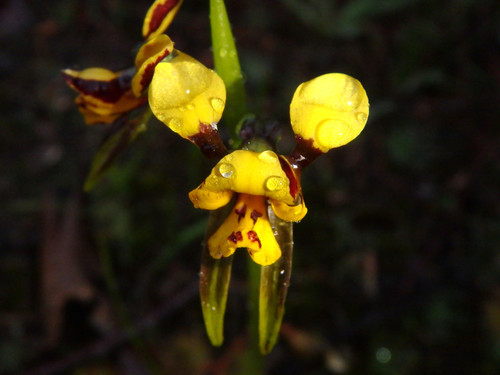
Diuris palustris Lindl. is a tuberous, perennial herb. It produces a tuft of eight to ten twisted, linear leaves that are 100–300 mm (4–10 in) long, 4–6 mm (0.16–0.24 in) wide, and folded lengthwise. Between one and four flowers 15–20 mm (0.6–0.8 in) wide are borne on a flowering stem that reaches 50–150 mm (2–6 in) in height. The flowers are yellow with dark brown spots and blotches. The dorsal sepal is erect, curved backwards near its tip, and egg-shaped, measuring 7–10 mm (0.3–0.4 in) long and 5–6 mm (0.20–0.24 in) wide. The lateral sepals are green, 12–15 mm (0.5–0.6 in) long, approximately 2 mm (0.08 in) wide, and are turned downwards, parallel to each other. The petals range from erect to curved backwards, with an egg-shaped blade 4–6 mm (0.16–0.24 in) long and 3–4 mm (0.1–0.2 in) wide, attached to a dark reddish brown stalk 3–4 mm (0.1–0.2 in) long. The labellum is 7–10 mm (0.3–0.4 in) long and has three lobes. The central lobe is spatula-shaped and 3–4 mm (0.1–0.2 in) wide, while the side lobes are erect, oval, 4–6 mm (0.16–0.24 in) long and 2–3 mm (0.08–0.1 in) wide, with rounded teeth near their tips. Two ridged calli 4–5 mm (0.16–0.20 in) long run along the mid-line of the labellum. Flowering occurs from August to October. This species, commonly called the swamp doubletail, is found in New South Wales, Victoria, Tasmania, and South Australia, where it is most common. It grows in moist or wet soil in forest, Callitris woodland, and grassland.