About Diuris orientis D.L.Jones
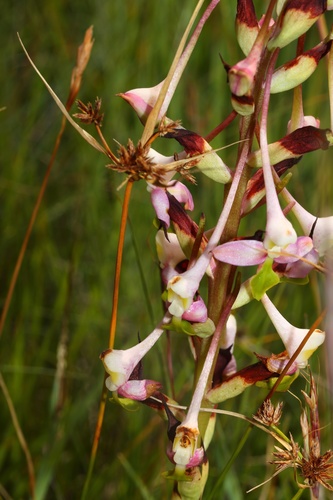
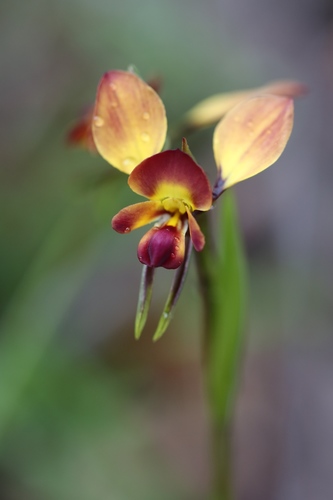
Diuris orientis is a tuberous, perennial, terrestrial herb, that usually grows 12–35 cm (5–10 in) tall. Up to three leaves emerge from the base of the plant; each leaf is linear to narrow lance-shaped, 10–30 cm (4–10 in) long, 5–10 mm (0.2–0.4 in) wide, and channelled. Up to 6 yellow flowers with reddish brown, purplish and mauve markings are borne on a raceme 8–40 mm (0.3–2 in) tall. The dorsal sepal is erect, broadly egg-shaped, and 9–15 mm (0.4–0.6 in) long and wide. The lateral sepals are greenish-brown, linear to lance-shaped, 12–23 mm (0.5–0.9 in) long, 3–4 mm (0.1–0.2 in) wide; they project down below the flower, and are parallel or sometimes crossed. The petals are erect and spreading, forming ear-like shapes above the flower. They are broadly egg-shaped, 12–20 mm (0.5–0.8 in) long, 8–12 mm (0.3–0.5 in) wide, attached to a greenish-brown, stalk-like claw 3–6 mm (0.1–0.2 in) long. The claw of the similar Western Australian species Diuris corymbosa is longer than this. The labellum is 10–14 mm (0.4–0.6 in) long and divided into three lobes. The lateral lobes are narrowly egg-shaped to wedge shaped, 7–11 mm (0.3–0.4 in) long, 2.5–4 mm (0.1–0.2 in) wide, and sometimes have a wavy margin. The medial lobe is 5–8 mm (0.2–0.3 in) long, wedge-shaped, strongly folded, and has a rounded tip. A callus made up of a narrow, yellow ridge is located near the base of the mid-lobe. Flowering of Diuris orientis usually occurs between September and November. This species, commonly called the eastern wallflower orchid, is widely distributed across South Australia, Tasmania and Victoria. In New South Wales, it is only found in the far south east, in and near the Nadgee Nature Reserve. In Victoria, it is fairly common in open forest and heath. Flowering of this species increases dramatically after summer bushfires.