About Diuris maculata Sm.
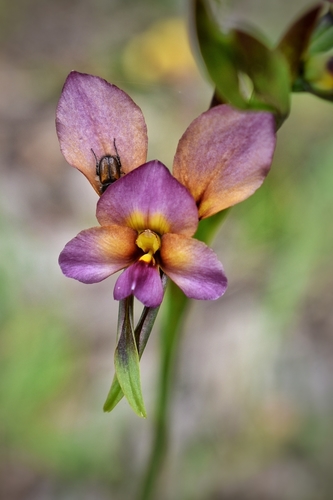
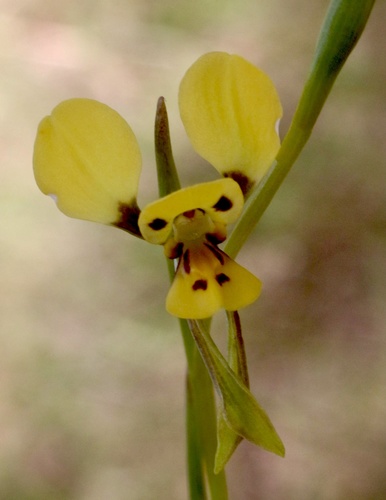
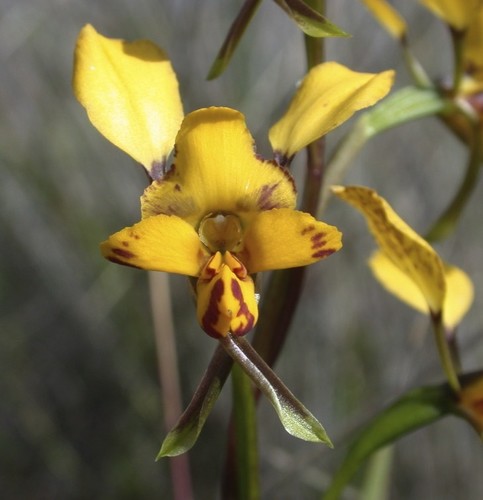
Diuris maculata Sm. is a tuberous perennial herb. It grows two or three linear leaves that are 150–250 mm long, 3–4 mm wide, and folded along their length. Between two and eight flowers, each 20–25 mm wide, are produced on a flowering stem that reaches 150–350 mm in height. The flowers are yellow with dark brown to blackish spots that appear on all flower parts, and sometimes occur on the reverse side of parts. The dorsal sepal is either erect or curved forwards, measuring 7–10 mm long and 5–7 mm wide. The lateral sepals are linear to lance-shaped, 10–15 mm long and about 2 mm wide, and they are turned downwards and crossed. The petals are either erect or curved backwards, with an egg-shaped blade 7–11 mm long and 6–9 mm wide attached to a blackish stalk 4–7 mm long. The labellum is 4–6 mm long and has three lobes. The central lobe is wedge-shaped, 3–5 mm long and 5–7 mm wide, while the side lobes are 4–7 mm long and 2–3 mm wide. Two ridged calli around 4–7 mm long run along the mid-line of the labellum. This species is similar to Diuris pardina, but differs by having lighter-colored flowers with smaller brown markings. Flowering takes place from July to November. This species, commonly called the spotted doubletail, grows in shrubby forest and heath habitat between Taree and Eden, occurring mainly in coastal and near-coastal areas. This orchid mimics the flowers of several native pea species, including Hardenbergia violacea and Daviesia ulicifolia. The native bee Trichocolletes venustus visits flowers of both this orchid and the mimicked peas. The bee obtains food from the pea flowers, but not from the orchid flowers. The orchid even has a UV nectar guide that matches the one found on the pea flowers.