About Diuris hazeliae D.L.Jones & C.J.French
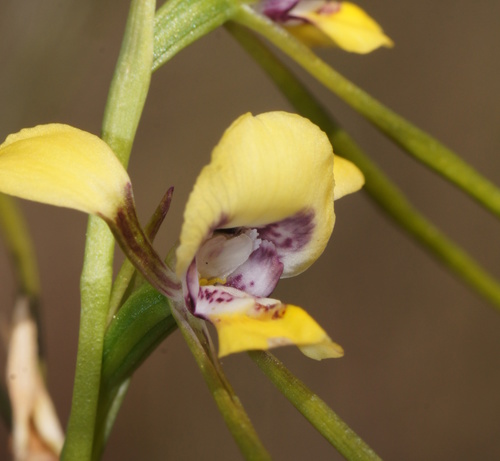
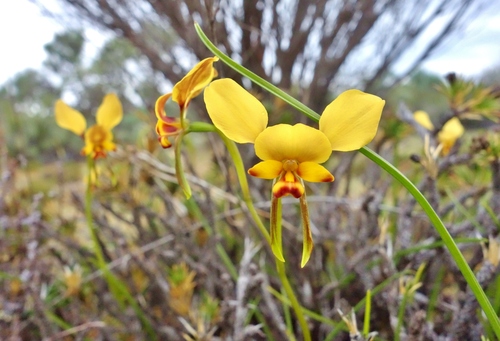
Diuris hazeliae is a tuberous, perennial herb. It produces between two and four linear leaves that are 100–300 mm (3.9–11.8 in) long and 4–7 mm (0.16–0.28 in) wide. Up to six bright yellow and reddish-brown flowers, 35–55 mm (1.4–2.2 in) long and 25–35 mm (0.98–1.38 in) wide, grow on a flowering stem 150–400 mm (5.9–15.7 in) tall. The dorsal sepal of this species is broadly elliptic, measuring 11–15 mm (0.43–0.59 in) long and 15–20 mm (0.59–0.79 in) wide. Its lateral sepals are narrowly oblong, 18–28 mm (0.71–1.10 in) long and 3–4 mm (0.12–0.16 in) wide, and they are usually crossed and curved backwards. The petals are roughly oblong to elliptic, 16–25 mm (0.63–0.98 in) long and 10–13 mm (0.39–0.51 in) wide, attached to a blackish stalk 5–7 mm (0.20–0.28 in) long; they are more or less erect and spread apart from each other. The labellum is 8–11 mm (0.31–0.43 in) long with a strongly down-curved tip and three lobes. The centre lobe is broadly wedge-shaped, 7–10 mm (0.28–0.39 in) long and 9–12 mm (0.35–0.47 in) wide. The side lobes spread widely apart, are oblong in shape, and measure 9–12 mm (0.35–0.47 in) long and 4.5–7 mm (0.18–0.28 in) wide. A single yellow callus ridge 5–7 mm (0.20–0.28 in) long, surrounded by a reddish brown mark, sits near the mid-line of the labellum. Flowering occurs from mid-August to September. This species, commonly known as the yellow granite donkey orchid, grows on and around granite outcrops. It occurs in a broad band stretching between East Yuna, Paynes Find, Coolgardie, Norseman and Esperance, within the Avon Wheatbelt, Coolgardie, Geraldton Sandplains, Mallee and Yalgoo bioregions of south-western Western Australia.