About Diuris chryseopsis D.L.Jones
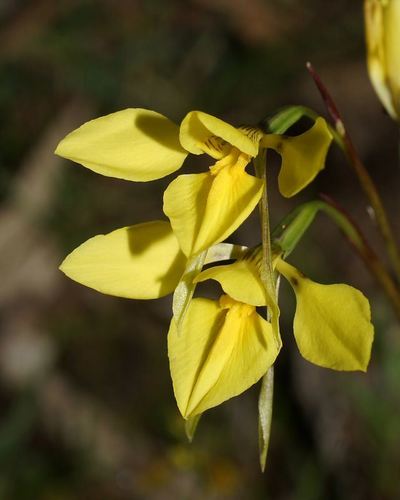
Diuris chryseopsis D.L.Jones is a tuberous perennial herb. It produces between two and five, sometimes up to eight, green linear leaves that grow 50–220 mm (2–9 in) long and 2–3.5 mm (0.08–0.1 in) wide, arranged in a loose tuft. Its flowering stem is 100–300 mm (4–10 in) tall, and bears up to four drooping lemon yellow flowers with brownish markings. Each flower is 17–30 mm (0.7–1 in) wide. The dorsal sepal is more or less erect, shaped egg-shaped to lance-shaped, 10–15 mm (0.4–0.6 in) long and 4–8 mm (0.2–0.3 in) wide. The lateral sepals are linear to lance-shaped, 15–25 mm (0.6–1 in) long and 2–3.5 mm (0.08–0.1 in) wide, and point downwards. The petals are lance-shaped to narrowly egg-shaped, 8–20 mm (0.3–0.8 in) long and 3.5–7 mm (0.1–0.3 in) wide, borne on a blackish stalk 3–5 mm (0.1–0.2 in) long, and are oriented sideways. The labellum is 14–20 mm (0.6–0.8 in) long and has three lobes. The central lobe is egg-shaped to heart-shaped, 9–16 mm (0.4–0.6 in) long and 7–12 mm (0.3–0.5 in) wide; the side lobes are oblong to wedge-shaped, 2–3.5 mm (0.08–0.1 in) long and 1–2 mm (0.04–0.08 in) wide. The labellum callus is densely hairy or pimply near its base and tapers toward the tip of the labellum. Flowering occurs from August to October. This species, commonly called common golden moths, grows in moist locations within forest, woodland and grassland habitats. It is found in south-eastern New South Wales, Tasmania, and widespread across Victoria where it is common. It may also occur in south-eastern South Australia. It resembles other species in the Diuris genus, and often forms hybrids with related species that share the same growing range.