About Diuris behrii Schltdl.
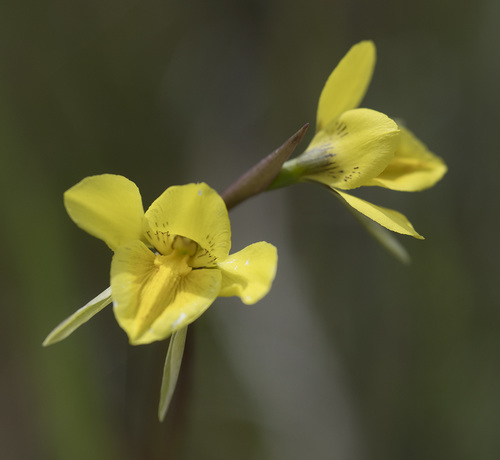
Diuris behrii is a tuberous, perennial herb that grows between three and six grass-like, narrow linear leaves, each reaching up to 200 mm (8 in) in length. Up to four drooping, bright yellow flowers are produced on a flowering stem that can grow up to 500 mm (20 in) tall. Each flower’s pedicel is enclosed by a bract. The dorsal sepal is egg-shaped, up to 17 mm (0.7 in) long, leans forwards, and has dark streaks matching those found on the labellum. The lateral sepals are greenish, linear to lance-shaped, up to 25 mm (1 in) long, and turn downwards to lie parallel to each other. The petals spread sideways or droop; they are narrow egg-shaped to elliptic, up to 25 mm (1 in) long, and attach to a green, stalk-like "claw". The labellum is up to 28 mm (1 in) long, often marked with brownish streaks, and divided into three lobes. The central lobe is broadly wedge-shaped and often has irregular edges. The lateral lobes are small, oblong, and have toothed edges. Two ridge-like calli, each around 5 mm (0.2 in) long, are located near the mid-line of the labellum. Flowering takes place from September to November. This species, commonly called the golden cowslip orchid, grows in grassland and woodland habitat. It occurs mostly in western Victoria, and is also found in south-eastern South Australia. Plants that were previously classified as D. behrii in New South Wales and the Australian Capital Territory are now separated into the distinct species Diuris amabilis.