About Distichlis spicata (L.) Greene
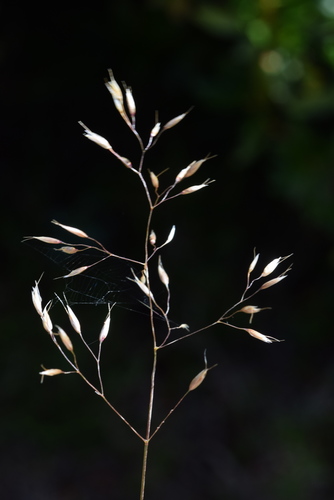
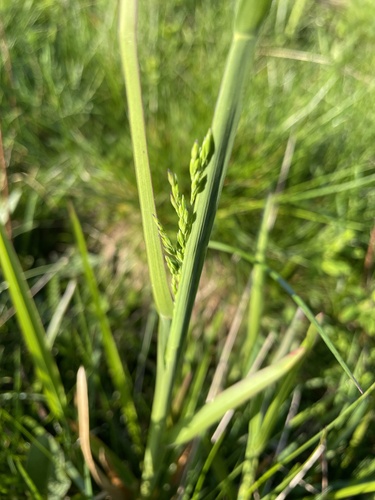
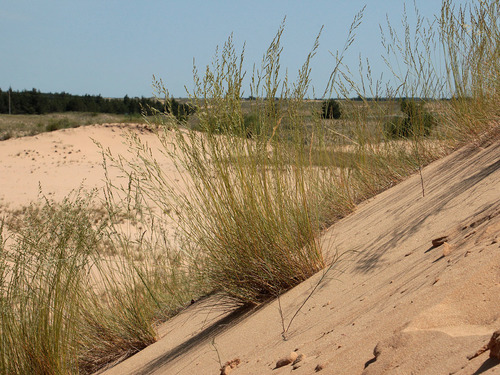
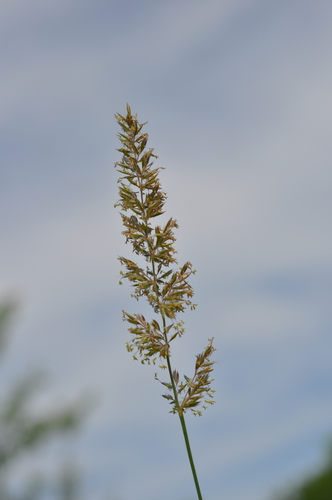
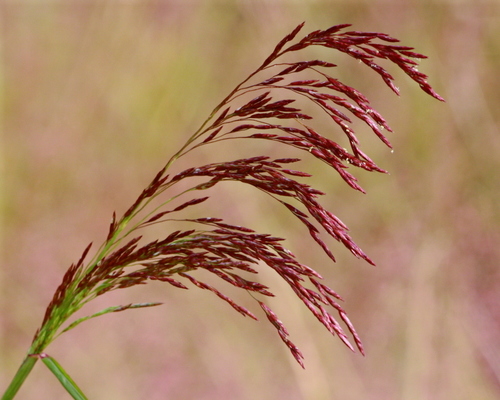
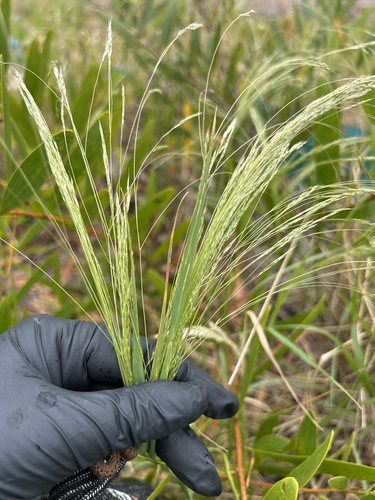
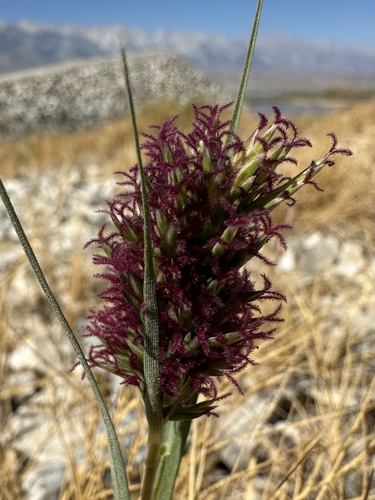
Distichlis spicata (L.) Greene is a hardy perennial grass that grows from rhizomes, and sometimes also from stolons. It is an erect grass that occasionally reaches close to half a meter in height, but is generally shorter. Its solid, stiff stems bear narrow leaves that can grow up to 10 centimeters long; in saline environments, these leaves may be crusted with salt. This species is dioecious, meaning male flowers and female flowers grow on separate individual plants. The female (pistillate) inflorescence can grow up to 8 centimeters long, and holds green or purple-tinted spikelets. Male (staminate) flowers look quite similar to female flowers, though they are thinner, larger overall, and more densely packed. Flower parts of both sexes may be bright pinkish-purple. Distichlis spicata thrives in coastal areas, salt flats, and disturbed soils, and can also be found in forest, woodland, montane, and desert scrub habitats. It can form dense, monotypic stands, and often grows in clonal colonies. Non-clonal populations tend to be skewed toward a majority of one sex over the other. This grass forms sod with its robust root system. Its rhizomes have sharp points that let them penetrate hard soils, and contain aerenchymous tissues that allow the plant to grow underwater and in mud. It grows easily in salty and alkaline soils, and excretes salts from its tissues through salt glands. Because this species secretes excess salt onto its surfaces, Kawaiisu Indians could make salt blocks by scraping off this accumulated salt. Studies have shown that under favorable soil and moisture conditions, saltgrass works well for pastures irrigated with saline water. On such land, total dry matter yields reach 9081 kg per hectare, with a total protein production of 1300 kg per hectare. Saltgrass is grazed by both cattle and horses, and has a fair to good forage value. This is because it stays green when most other grasses are dry during drought periods, and it is resistant to grazing and trampling. It is harvested both when green and when dry, and is most commonly used as winter livestock feed. Along the Atlantic coast, saltgrass was the primary source of hay for early colonists.