About Disphyma crassifolium (L.) L.Bolus
Growth Habit
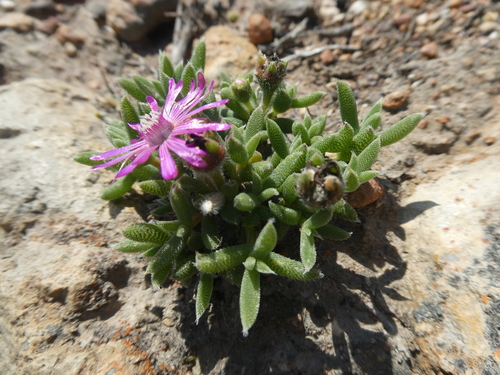
Disphyma crassifolium is a prostrate, succulent annual or short-lived perennial shrub.
Size
It usually reaches 2 to 30 cm (0.79 to 11.81 inches) in height, and its stems can grow as long as 2 m (6 feet 7 inches).
Leaf Shape
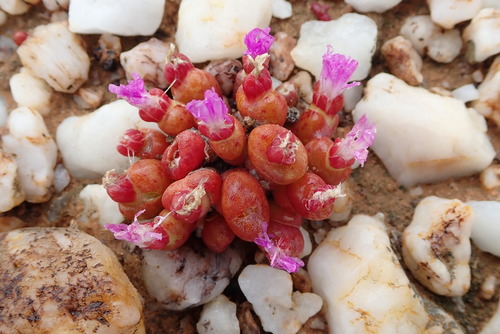
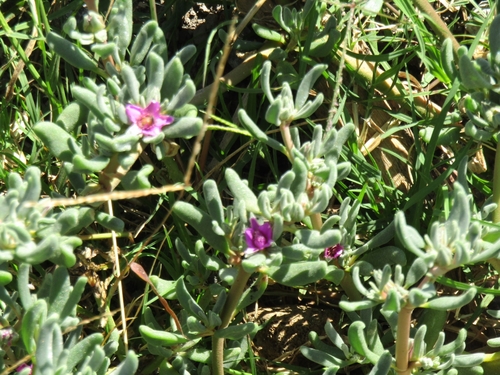
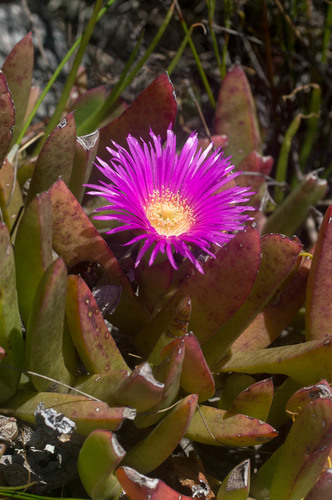
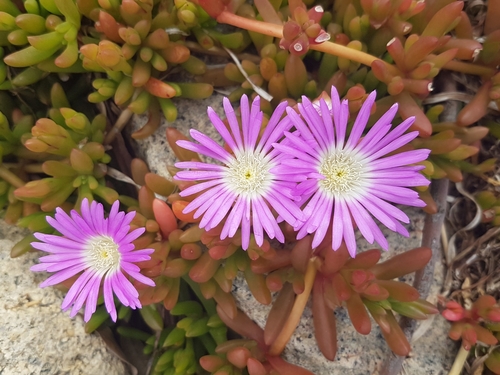
Its leaves are club-shaped, with cross-sections that are roughly round to three-sided.
Leaf Dimensions
Leaves are 5 to 70 mm (0.20 to 2.76 inches) long and 1 to 7 mm (0.039 to 0.276 inches) wide.
Flower Dimensions
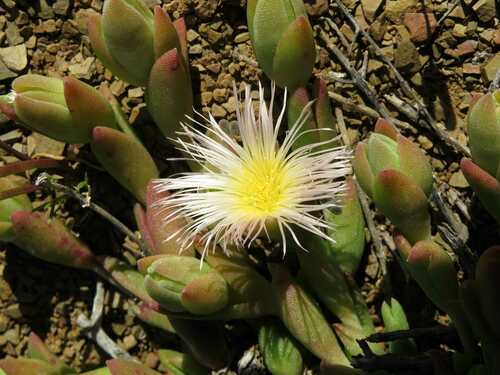
Flowers are 20 to 50 mm (0.79 to 1.97 inches) wide, with a perianth tube 6 to 12 mm (0.24 to 0.47 inches) wide.
Flower Lobe Length
The longer flower lobes are 2 to 30 mm (0.079 to 1.181 inches) long.
Staminode Characteristics
Petal-like purple staminodes are 10 to 30 mm long, and are white on their lower surface.
Flowering Period
Flowering mostly occurs between October and February.
Fruit Characteristics
The fruit is a conical capsule that measures roughly 10 mm (0.39 inches) in both length and width before it opens.
Distribution Range
Disphyma crassifolium is widely distributed in South Africa and Australia.
Habitat
It grows in saline environments like coastal dunes and samphire flats, and tolerates multiple soil types including sand, loam, and clay.