About Dispholidus typus (Smith, 1828)
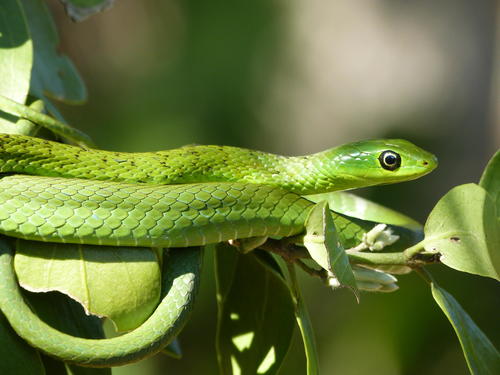
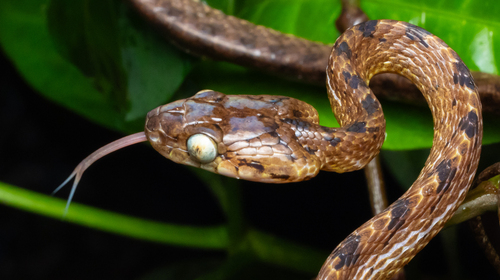
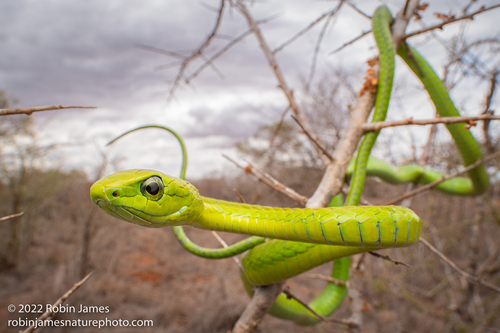
The average adult boomslang (Dispholidus typus) reaches a total length of 100–160 centimetres (3.3–5.2 ft, including the tail), and some individuals grow longer than 183 centimetres (6.00 ft). This species has exceptionally large eyes, and a characteristic egg-shaped head that is distinctly separate from the neck, with a clearly defined canthus rostralis. The pupil of the large eye is round, and boomslangs have excellent eyesight; they often move their head from side to side to get a clearer view of objects directly in front of them.
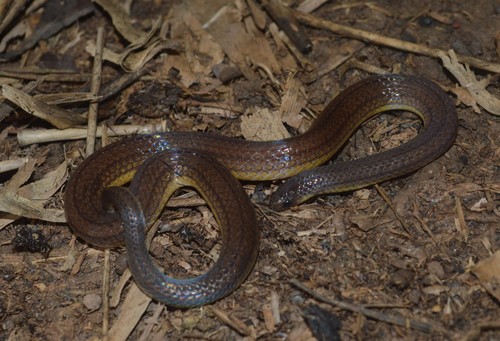
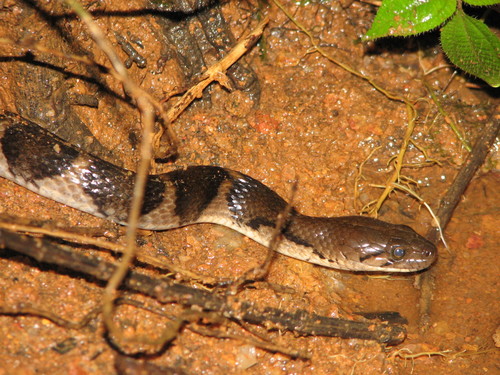
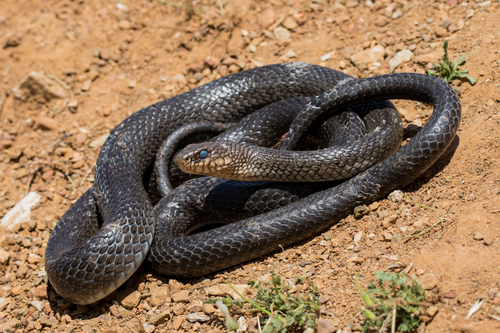
Colouration in this species is highly variable, and shows clear sexual dimorphism: males are typically light green with black or blue scale edges, while adult females are often brown. Adult body weight ranges from 175 to 510 g (0.386 to 1.124 lb), with an average weight of 299.4 g (0.660 lb).
For dentition, the maxillary teeth are small and number seven or eight at the front of the jaw, followed by three very large, grooved fangs positioned below each eye. Mandibular teeth are roughly equal in size. The body is slightly compressed. Dorsal scales are arranged in 19 or 21 rows; they are very narrow, oblique, strongly keeled, and have apical pits. The boomslang has a long tail, with paired subcaudal scales. Ventral scales number 164–201, the anal plate is divided, and subcaudals number 91–131.
Boomslangs are endemic to Sub-Saharan Africa. Their range extends from The Gambia, Guinea, and Senegal across most of West Africa (including Benin, Cameroon, Ghana, Nigeria, and Togo), through Central and Eastern Africa (Democratic Republic of the Congo, western Ethiopia, Kenya, South Sudan, Tanzania, and Uganda), and across much of Southern Africa. Some of the species' densest populations occur in Angola, Botswana, Eswatini, Malawi, Mozambique, Namibia, South Africa, Zambia and Zimbabwe, and it occupies a wide array of habitats across this range.
The boomslang is an excellent climber and highly arboreal, living mainly in forested areas. It also occurs in karoo shrubs, savannahs, lowland forests, and grasslands. It is not restricted to trees, and can often be found hunting, feeding, or taking shelter on the ground. It will occasionally hide underground during harsh weather conditions.
This species is oviparous. Adult females produce an average of 8 to 14 leathery eggs per clutch, though clutches as large as 27 eggs have been observed. Eggs are deposited in hollow tree trunks or rotting logs, and have a relatively long incubation period that averages three months. Hatchling males are grey with blue speckles, while hatchling females are pale brown. Individuals do not develop their full adult colouration until several years after hatching. Newly hatched boomslangs measure about 29 cm (11 in) to 38 cm (15 in) in length and do not pose a threat to humans, but become dangerously venomous once they reach a length around 45 cm (18 in) and a girth as thick as an adult's smallest finger.