About Disparoneura quadrimaculata (Rambur, 1842)
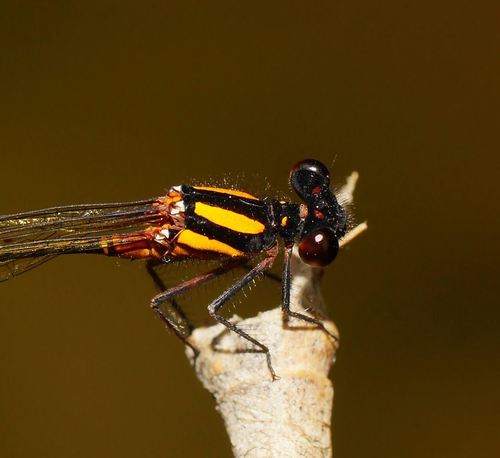
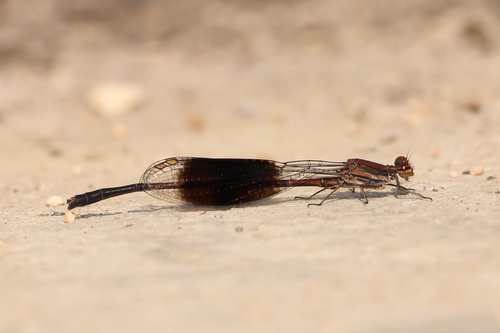
Disparoneura quadrimaculata (Rambur, 1842) is a medium-sized damselfly. Mature males have brick-red eyes marked with two horizontal dark-red equatorial lines. The dorsum of the male thorax is bright brick-red, and the sides are paler; markings on the thorax include a narrow black mid-dorsal carina, an ante-humeral stripe, a generally broken but broad humeral stripe, a broader irregular stripe on the mesepimeron that is often broken into two or more spots, a short stripe on the antero-lateral suture, and a narrow stripe on the postero-lateral suture. The base of the lateral side of the thorax is pale yellowish-red.
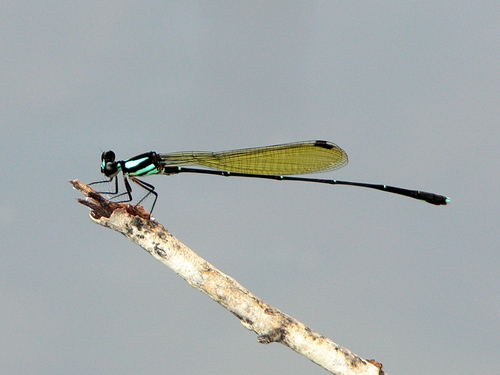
The wings of this species are transparent. Forewings have a broad blackish-brown fascia that extends from the node to the pterostigma. Hindwings have a similar fascia that begins about 5 cells distal to the node and extends to the pterostigma. The pterostigma is bright ochreous, bordered by thick black nervures.
The male abdomen is reddish-brown with black markings. Segment 1 and segments 7 through 9 are entirely black. Segments 2 through 6 are reddish-brown with broad black markings at their apical ends. Segment 10 and the anal appendages are pale brown.
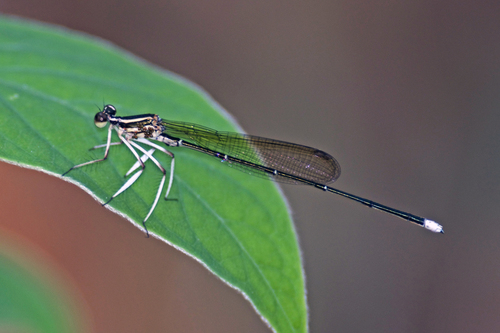
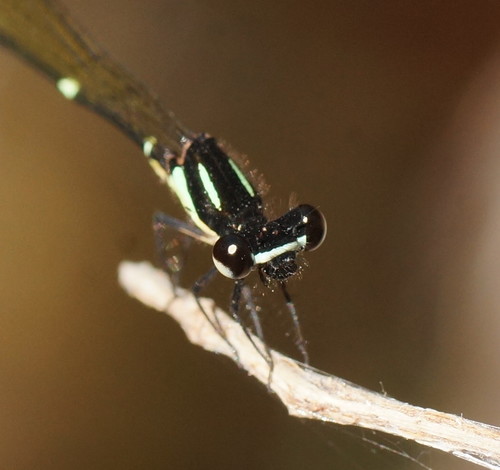
Females are more robust than males and have extensive black markings. Their thorax and abdomen are greyish-brown. The abdomen is black on the dorsum, and segments 3 through 7 have broad white apical annules followed by black. Segments 3 through 8 have small paired white spots at the base, surrounded by black. Segments 8 through 10 have white markings on the dorsum.
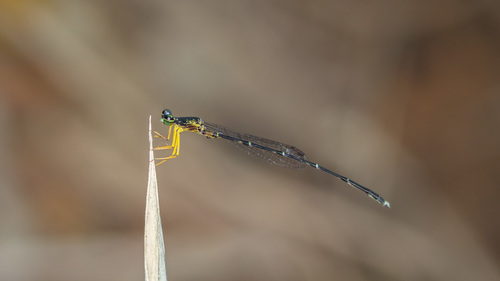
This damselfly is commonly found along streams and rivers, where it perches on emergent boulders and aquatic plants. It breeds in hill streams.