About Dispar compacta (Butler, 1882)
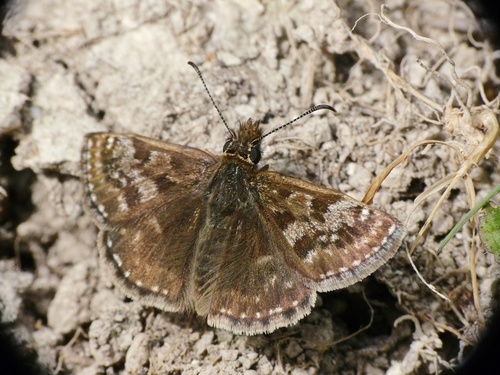
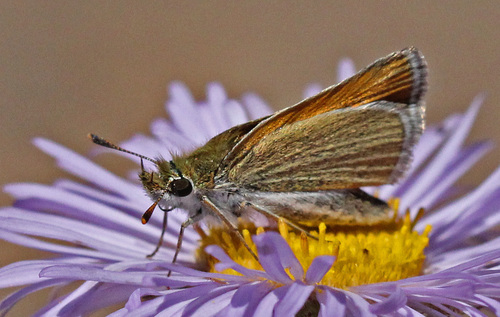
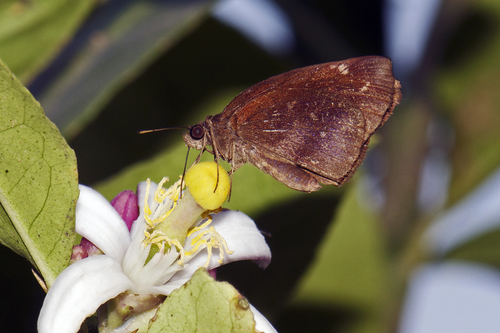
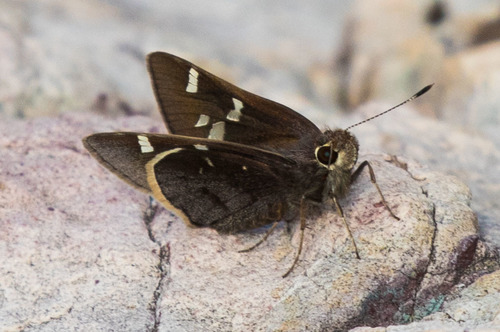
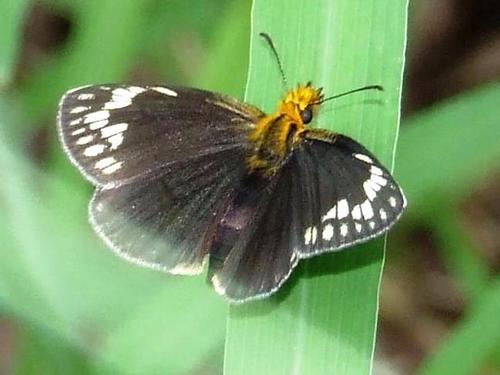
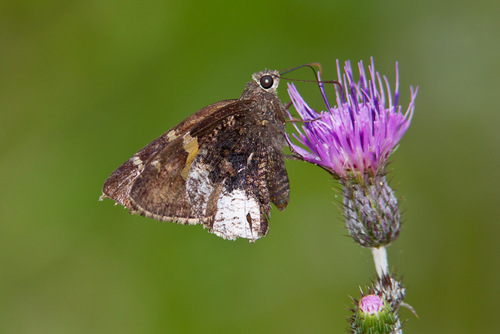
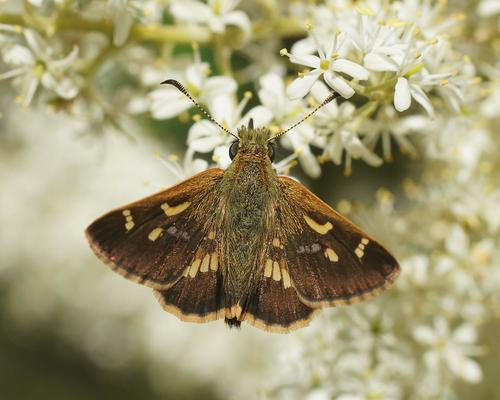
Dispar compacta, first described by Butler in 1882, has distinct life stage characteristics and observable sexual dimorphism in adult wing markings. Adult D. compacta have brown upper wing surfaces and orange-brown lower wing surfaces, with white or cream markings, and a wingspan of approximately 23 mm (0.91 in). Male and female D. compacta have different wing markings. From above, each male forewing has a cream-coloured hook-shaped marking, a central spot, a band of three subapical spots, and a central band of grey sex scales; each male hindwing has a band of four cream-coloured postmedian spots. From above, each female forewing has two central spots, a band of three subapical spots, a spot near the middle of the leading edge, and a spot near the trailing edge. Female forewings lack the hook-shaped marking and grey sex scales found on male forewings, and each female hindwing has a central yellow patch. From below, male forewings and hindwings have markings similar to their upper surfaces. From below, female forewings have markings similar to their upper surfaces, and female hindwings have a band of whitish-grey spots edged with brown; both female forewings and hindwings are suffused with purplish-grey. D. compacta eggs are dome-shaped, white to cream in colour, measuring approximately 0.7 mm (0.028 in) by 0.6 mm (0.024 in), with 12–14 longitudinal ribs. As the egg develops, a purplish-red dorsal spot and lateral band appear. First instar larvae are yellowish, turning green after they begin feeding, with a large, shiny black head and a dark red prothoracic plate. Second instar larvae are similar to first instar larvae, but develop a broad white longitudinal dorsal band with a narrow green dorsal line at its centre. Third instar larvae resemble second instar larvae, but their head surface becomes rough, and both the head and prothoracic plate turn brown. By the fifth and final instar, the larva reaches 18–20 mm (0.71–0.79 in) in length. Final instar larvae are greenish-pink, with a diffuse, pale longitudinal dorsal band, a darker central line within the dorsal band, and a narrow white longitudinal subdorsal line. Pupae are cylindrical, brown, 12–15 mm (0.47–0.59 in) long, and covered with a white powder. D. compacta is found in the Australian Capital Territory, New South Wales, Queensland, South Australia, and Victoria. It inhabits moist grasslands, open forests, and shaded urban parks and gardens where grasses grow. D. compacta larvae feed primarily on grasses including Ehrharta erecta, Microlaena stipoides, Poa labillardieri, Poa queenslandica, Poa sieberiana, and Poa tenera. Other host plants used by larvae include Gahnia species and Lomandra species. Some larvae feed on the new growth of invasive kikuyu grass (Cenchrus clandestinus), but this grass is toxic to the larvae. D. compacta is univoltine, meaning it produces one generation per year. Eggs are usually laid singly, rarely in pairs or short rows, on host plant leaves or leaf litter. Egg development starts immediately, but larvae do not emerge until autumn. After hatching, a larva eats its egg shell before moving away. When a larva finds a suitable host plant, it constructs a shelter by folding or rolling the host leaf and holding it in place with silk. Larvae are nocturnal: they hide in their leaf shelter during the day and emerge to feed at night. Larval growth is slow over winter, accelerates in spring, and larvae begin to pupate in late December, with adults emerging in January and February. Adult D. compacta are active between January and April, and may be locally abundant in some areas. They fly low to the ground, typically in grassy areas, and actively feed on flowers. Males perform hilltopping, and can be seen patrolling their territory or perched high in the canopy.