About Disocactus anguliger (Lem.) M.Á.Cruz & S.Arias
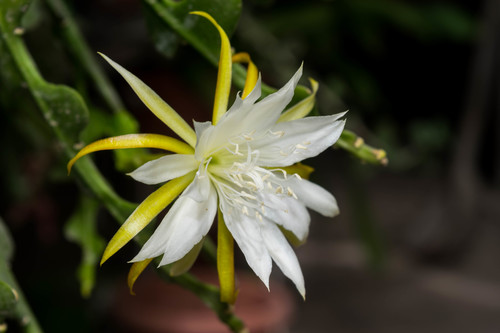
Disocactus anguliger (Lem.) M.Á.Cruz & S.Arias is an epiphytic cactus. It has smooth green skin and extensively branched stems; primary stems are often woody, while secondary stems are flat and succulent. Secondary stems measure 20–30 cm long and 3–5 cm wide, with deep lobes that are rectangular or slightly rounded. This species produces white or pale yellow nocturnal flowers that give off a strong, sweet scent. The flowers are 6–20 cm long and 6–7 cm wide. Its ovoid fruit is 3–4 cm long and 2 cm in diameter, with a brownish, greenish or yellowish outer color. The tasty fruit has an interior similar to kiwifruit, with green pulp and small black seeds. This species is endemic to Mexico, where it grows as an epiphyte in evergreen forests in Oaxaca, Guerrero, Jalisco, and either Michoacán or Nayarit. It occurs at elevations between 1,100 and 1,800 m. In 1846, the Horticultural Society of London obtained this plant from collector T. Hartweg and first distributed it to Europe. In cultivation, this is an easily grown, fast-growing epiphyte. It needs a compost mix with plenty of humus and sufficient moisture during the summer. It grows best at 16–25 °C (61–77 °F), but can tolerate short periods at temperatures between 10–15 °C (50–59 °F). It should be grown in semi-shade, and flowers in late autumn or early winter.