About Disocactus ackermannii (Haw.) Ralf Bauer
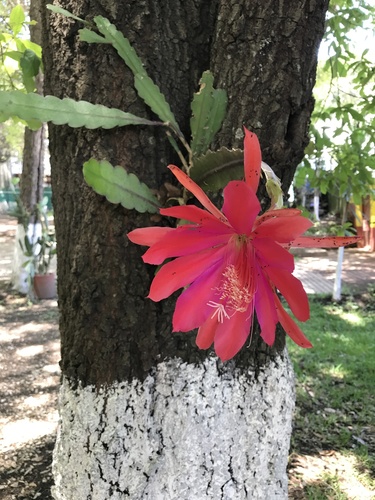
Disocactus ackermannii (Haw.) Ralf Bauer has stems that start with a short, rounded base, which measures 10–18 cm (4–7 in) long. Above this base are longer flattened, leaf-like stem sections 10–75 cm (4–30 in) long and 5–7 cm (2–3 in) wide with wavy edges. The plant branches from its base, grows with an arching downward habit, and reaches a total length of around 1 m (3 ft). Its funnel-shaped scarlet flowers have greenish throats, measuring 11–15 cm (4.3–5.9 in) or longer in length, and up to 15 cm (5.9 in) across. The flower filaments are red, though their bases are typically greenish; the anthers are pale rose, the style is red, and the stigma is purplish. After fertilization, flowers develop into green to brownish red fruits that are 4 cm (1.6 in) long and 2–2.5 cm (0.8–1.0 in) wide.
This species is native to the southern Mexican states of Chiapas, Oaxaca, Puebla, and Veracruz. It grows in cloud forests of the Sierra Madre de Oaxaca and Chiapas Highlands, at elevations between 1,800 and 2,500 meters.
In cultivation, Disocactus × jenkinsonii, a hybrid between D. phyllanthoides and D. speciosus, has often been confused with D. ackermannii and is frequently distributed under the name "Phyllocactus ackermannii". Disocactus ackermannii has been awarded the Royal Horticultural Society's Award of Garden Merit.