About Disholcaspis prehensa Weld, 1957
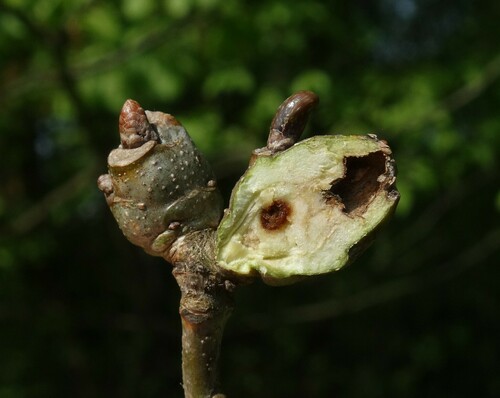
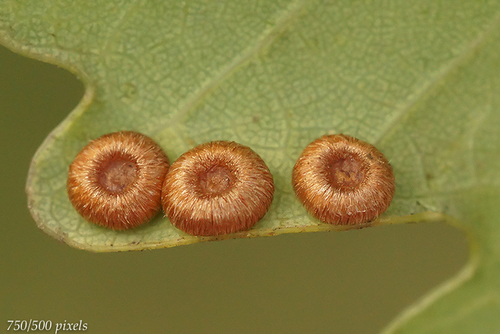
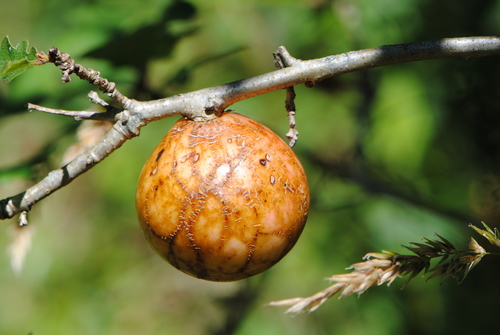
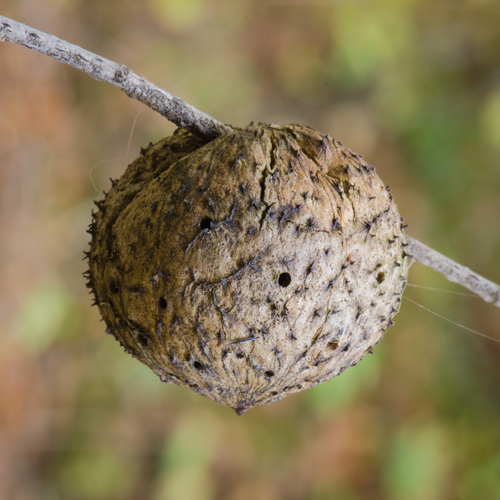
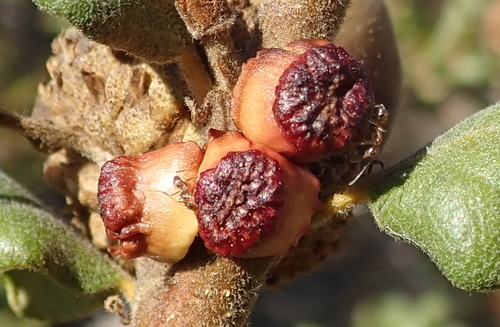
Disholcaspis prehensa, commonly called the clasping twig gall wasp, is a species of gall-inducing wasp. It is native to California, where it induces galls on both scrub oak and leather oak. The life cycle of Disholcaspis prehensa alternates between an asexual (agamic) generation and a sexual generation, which produce two different types of galls at different times of year. In spring, females from the previous sexual generation lay eggs in young twig tissue. This leads to the formation of conspicuous mushroom-shaped galls that mature by early summer. The base of each gall has sharp edges and broadly wraps around the twig it grows on, which gives the species its common name. These galls measure 7–10 mm high, and around 10 mm wide at the base. Their sun-facing side is more red, and their shaded side is more yellow; they eventually turn brown as they age. Larvae develop inside an elliptical chamber at the base of the gall, and emerge as adults from the sides of the gall in late winter or early spring. All emerging adults are female, and they reproduce parthenogenetically, laying their eggs into the dormant leaf buds of California scrub oak. New galls from these eggs develop the following spring as the oak's leaves begin to open. Unlike the asexual generation's galls, these spring galls stay hidden inside the bud. They are only 2.2–3.5 mm in size, oblong in shape, and light brown in color. By late spring, the new sexual generation of adults emerges through holes near the tips of their galls. At this point, adult males and females mate to start the life cycle over again. Young agamic galls often cause the host oak tree to exude a honeydew-like phloem sap that attracts ants, yellowjackets, and bees. It is thought that ants specifically protect the developing wasp larvae from parasitoid wasps.