About Discolampa ethion (Westwood, 1851)
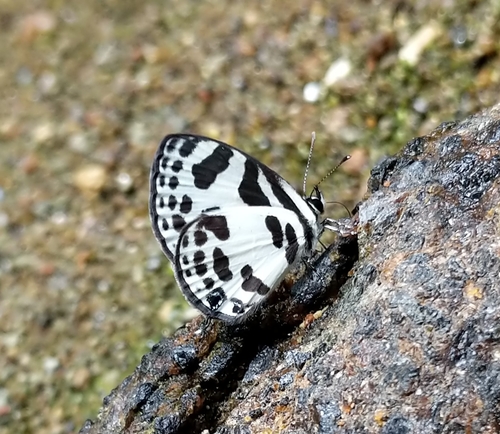
Discolampa ethion (Westwood, 1851). The description below is reproduced from Charles Thomas Bingham’s 1907 work Fauna of British India: Butterflies Volume II. For male individuals: Upperside of both forewings and hindwings is crossed obliquely through its middle section by a very broad, pure white band. This band is broadly bordered with dark blue along both its inner and outer margins, and does not extend onto the forewing above vein 6. Just above vein 3, the band projects outwards for a short distance, from which the inner margin of the dark blue edging runs obliquely to vein 6. The extreme bases of the wings are black; the costal margin of the forewing and the terminal margins of both forewings and hindwings are broadly black. Both wings have a light iridescent blue suffusion spreading outwards from the base. Underside is snow-white, with the following jet-black markings on both wings. On the forewing: two broad, roughly parallel streaks extend obliquely from the base to the costa; the outer streak curves apically and coalesces with the inner streak on the costa. The costal margin is very narrowly edged with black. A short, anterior, post-discal, outwardly oblique bar that is slightly club-shaped towards the posterior runs between the costa and vein 5. Opposite this bar, between the dorsum and vein 3, there is a similar bar that is erect and not club-shaped at the apex. Beyond these bars, there is a complete inner and outer transverse subterminal series of spots, followed by a slender anteciliary black line. The spots of the inner subterminal series are square-shaped, and the spots of the outer series are linear; the two posterior spots of the inner series are very large. Finally, there is a single detached postdiscal spot in interspace 3, positioned very close to the inner subterminal line of spots. On the hindwing: there is a short curved basal band that does not extend to the costa, a spot touching the middle of the band on its outer side, and a transverse discal band that is twice widely interrupted. The middle portion of the discal band is shifted outwards, and the lower portion has a spot on its outer margin joined to it. Subterminal and terminal markings match those on the forewing. Antennae, head, thorax, and abdomen are black; on the underside, palpi, thorax, and abdomen have a median longitudinal white line. For female individuals: Upperside is similar to that of the male, but the median white transverse band crossing both wings is broader, extends onto the forewing up to vein 7, and has no blue inner edging or iridescent light blue speckling. The black colouring at the wing bases and margins is less intensely shaded, and is more brownish black. Underside ground colour and markings are very similar to the male; the two oblique basal bands on the forewing are generally farther apart than they are in the male. The larva: The caterpillar feeds on young shoots of Ziziphus jujuba. It has the woodlouse body form but is flattened. While its texture appears smooth, examination with a lens reveals it is thickly covered with white hairs. Its colour is greenish white with a faint green dorsal band. The pupa: It is similar in shape to the pupa of Castalius rosimon Fabricius, but is smaller and narrower. It is bright apple-green with a darkish green line running down the centre, and has some small red dots on the edges of the wing-cases. This butterfly is distributed across Sri Lanka, South India, and the area from Sikkim to Assam extending into Myanmar. It also occurs in the southern Andaman Islands and Nicobar Islands. In Southeast Asia, it is found in Cambodia, Thailand, Laos, Vietnam, Hainan, the Malay Peninsula, Singapore, Sumatra, Java, Borneo, the Philippines, Palawan, Nias, Sumbawa, the Anambas Islands, and Sulawesi.