About Disa uniflora P.J.Bergius
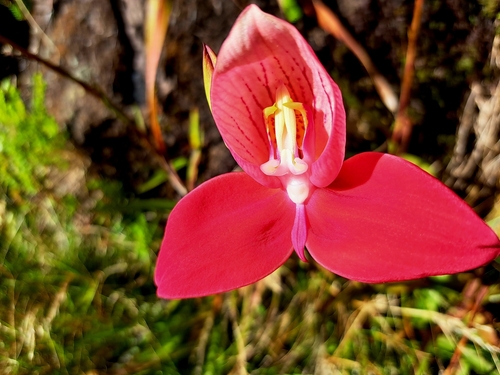
Disa uniflora P.J.Bergius is a fairly stout perennial orchid that reaches 15 to 60 cm in height, and spreads via stolons. Its leaves are lance-shaped: lower leaves are spreading or semi-erect, and can grow up to 25 cm long. Its inflorescence produces 1 to 3 flowers. The blooms are showy; across the laterally spreading sepals, they can measure 10 cm across. The laterally spreading sepals are colored scarlet to carmine. The central upright sepal is pinkish on the inner surface, with scarlet veins. The petals are much smaller than the sepals, are erect, and are yellow with red spots at their tips, turning pale scarlet toward their bases. This species blooms in the summer, most heavily in January, and continues flowering into March. This orchid’s range is restricted to the Sandstone Mountains of the South Western Cape, South Africa. It occurs from west of Hermanus to Table Mountain, and extends north into the Cederberg Mountains. It is common on Table Mountain and Back Table, but is rarely seen further south on the Cape Peninsula. It grows near waterfalls, streamlets, and mountain seeps, and is never found along the shores of dams with considerable annual water level fluctuations. Its pollination strategy is among the most complex of all orchids, and depends on the mountain pride butterfly, Aeropetes tulbaghia. Though the flowers are unscented, they attract the butterfly with their bright red color and provide a reward of nectar. This differs from its congener Disa ferruginea, which is also exclusively pollinated by the mountain pride butterfly but offers no nectar reward, instead attracting the butterfly by mimicking nectar-producing flower species.