About Dirca palustris L.
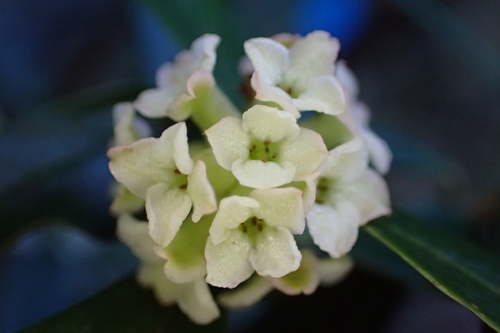
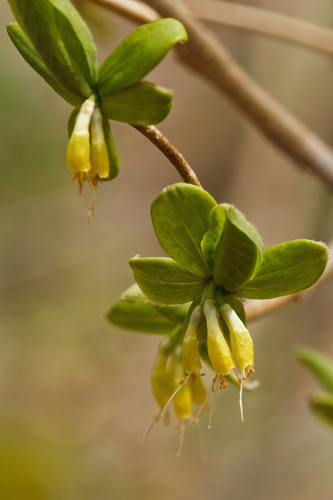
Dirca palustris L., commonly called leatherwood, is a widely branching, usually multi-stemmed woody shrub that reaches a maximum vertical height of 3 meters. Leatherwood is monoecious, and produces bisexual flowers. The pale yellow, bell-shaped flowers are made up of joined sepals with no petals. They are borne in axillary clusters of 2 to 7 flowers. Each flower has 8 long stamens. The stalks of the flower clusters measure 1⁄8–3⁄8 inch (3–10 mm) long when the plant is flowering, and elongate to about 1⁄4–1⁄2 inch (6–13 mm) by fruiting time. The stalks of individual flowers are smooth and grow up to about 3⁄8 inch (10 mm) long; sometimes 2 or more of these stalks are fused nearly all the way to their tips. The flower buds are small and conical, with 4 distinct dark, silky bracts that remain on the plant after flowering. It blooms from late March to April, and flowers before new leaves emerge. The flowers fall off as the new leaves expand. Leatherwood produces fruit from May to June. The fruit is an oval to egg-shaped drupe, usually pale green or yellowish, and sometimes strongly tinged with red or purple; it often turns darker and redder as it ages. Each fruit contains a single, dark brown seed. The leaves are simple, alternately arranged, and 3.5–7 cm (1.4–2.8 in) long. Immature leaves have a hairy surface, are light green in color, and become smooth as the leaf matures. The leaf stalks are short, hairy, and hollow. The next year's leaf buds are hidden and covered by the base of the leaf stalk. The bark is mostly smooth and gray on old stems, roughened at the base of old trunks, and becomes very tough. The wood is soft, white, and brittle when dried. The twigs are yellowish brown or reddish brown and smooth. Stems have circular scars marking the start of each new growth cycle. Twigs are very flexible, and can be bent or even tied into knots without breaking. They are enlarged at the joints. D. palustris is a host plant for the leaf-mining larvae of the moth species Leucanthiza dircella. Its natural distribution extends from New Brunswick to Ontario in the north, and from northern Florida to Louisiana in the south. Within this range, its distribution is restricted to very specific site conditions, so the species occurs sporadically. It is found almost exclusively in mesic, relatively rich hardwood forests or mixed conifer-hardwood forests. It is most commonly encountered in the northern part of its range, and is a dominant shrub in some hardwood forests of the upper Great Lakes Region. Rich woods, sometimes swampy, are its main habitat, and it is occasionally cultivated. It is often hard to recognize, because its flowers emerge just before leafing, last a very short time, and D. palustris often grows mixed with the much more common spicebush, which also produces small yellow flowers before leaves that emerge at roughly the same time in early spring. Its closest relative, western leatherwood, grows across the continent in the San Francisco Bay Area. This plant is known to act as an emetic, laxative, and vesicant; some people develop severe skin irritation after contact with its bark. The fruits are mildly poisonous to mammals. Eight novel organic sulfur compounds, called dirchromones, have been isolated from dichloromethane extracts of the roots, bark, and wood. These compounds, the first sulfur-containing compounds identified in the family Thymelaceae, were found to have cytotoxic and mild antibacterial effects.