About Dipterostemon capitatus (Benth.) Rydb.
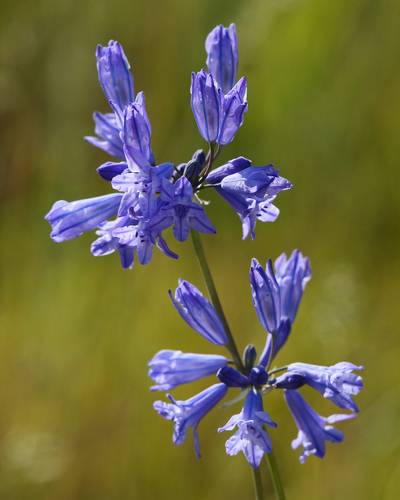
Dipterostemon capitatus is an herbaceous perennial plant that grows from an underground corm, reaching a maximum height of 60 cm. It produces 2 to 3 leaves that measure 10 to 40 cm in length. The plant's inflorescence is dense, shaped like either a head or an umbel, and typically holds 2 to 15 flowers. The flower perianth may be blue, blue-purple, pink-purple, or white. The flower tube ranges from 3 to 12 mm in length, and its shape varies from narrowly cylindrical to campanulate. Flowers have six fertile stamens that are deeply notched, lanceolate, and white; the stamens angle inward, are slightly reflexed at the tip, and their outer filaments are wider at the base. Other traits of the species include a twisted and fleshy peduncle, a set of membranous, petal-like stamen appendages surrounding the anthers, and angular black seeds. It reproduces both by seed and vegetatively via cormlets. Cormlets attach to the parent corm via stolons, are sessile, and form in the axils of old leaf bases on mature corms. This plant thrives in open, disturbed environments, and it is a common post-fire succession species in chaparral. Its flowering peaks in March. D. capitatus grows at elevations from sea level up to 2,300 meters, and it inhabits a wide range of plant communities, including vernal pools, valley grassland, scrub, coniferous forests, and open woodlands. It does not appear to colonize burned areas via seed, instead spreading via cormlets. After fire, plants grow in unshaded environments with low brush competition, and they flower vigorously in these open areas that have increased soil nutrients. Burned grasslands may develop thousands of D. capitatus plants where none have been visible in recent years. Corms can remain dormant underground for a decade or more, waiting for fire or other favorable environmental conditions before sprouting. Fire suppression leads to increased shade and greater plant competition, which causes D. capitatus populations to decrease in number. Native American groups in California, parts of the Great Basin, and the Southwest have gathered D. capitatus corms, which were an important source of starch in their traditional diets. Different California tribes and individual families harvest corms before flowering, during flowering, or after seeding, depending on their traditions. Traditional gathering sites were visited annually, and particular families owned and maintained specific gathering tracts that held multiple types of edible corms and bulbs. A range of animals including black bears, mule deer, non-native wild pigs, rabbits, and pocket gophers eat D. capitatus corms. Eating some corms helps disperse others: animals detach cormlets, which aerates the soil, prepares the seedbed, thins existing plant populations, and leaves some cormlets behind. Once separated, corms reach flowering size more quickly. Although plants grown from seed take a long time to begin flowering, D. capitatus is sometimes grown in horticulture. Its flowers work well in native plant beds, especially when contrasted with other California native species such as the California poppy Eschscholzia californica. With patience and proper care, these plants can produce very striking displays in spring.