About Dipsas articulata (Cope, 1868)
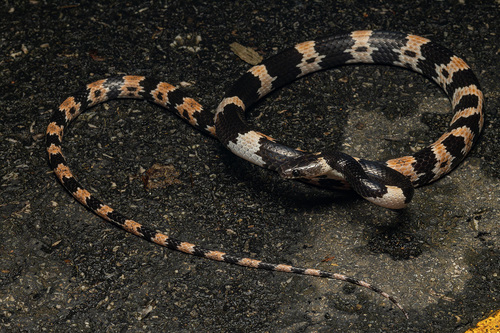
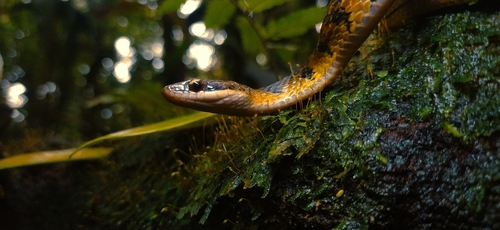
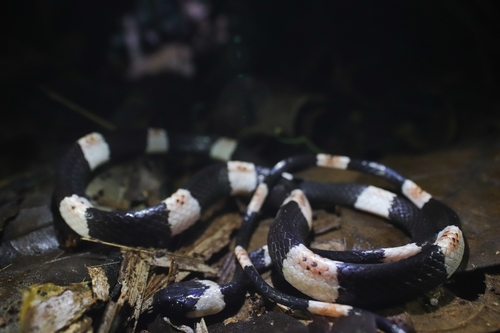
This species, Dipsas articulata, has a white dorsal ground color with 14 to 17 reddish-brown to black bands that are roughly equal in length along its entire body. Its pattern of alternating light and dark rings has led to it being classified as a coral snake mimic. Like other Dipsas species, D. articulata has large eyes, but it can be distinguished from other members of the genus by several small black spots on its head and the absence of the classic mental groove that other Dipsas species possess. This species has a unique scale arrangement: its sublabial scales are usually adjacent to the third pair of chin shields, and to either the preventral or ventral scales. Most adult individuals of this species measure between 460 and 483 mm, or 18.1 to 19.0 inches, in total body length. However, a large male specimen documented in 2011 had a 501 mm (19.7 in) snout-vent length, an 218 mm (8.6 in) tail length, and weighed 16 g (0.035 lb). This 2011 specimen became the longest known individual of the species on record, exceeding the previously published total length record of 712 mm (28.0 in). Many Dipsas snakes share very similar physical appearances, so researchers have worked to identify key distinguishing features, especially between D. articulata and the species D. viguieri, D. gracilis, D. brevifacies, and D. tenuisima. These species look extremely similar to the naked eye, and there is ongoing scientific debate about their taxonomy and evolutionary relationships to one another. As a result, researchers have defined an "articulata group" within the genus Dipsas that contains multiple related species, which is not the same as the distinct species D. articulata itself. The species included in this articulata group are D. articulata, D. bicolor, D. brevifacies, D. gaigae, D. gracilis, D. maxillaris, D. tenuissima, and D. viguieri, and the group is recognized as a monophyletic clade within Dipsas. The distribution of Dipsas articulata ranges from the lowlands of southeastern Nicaragua to northwestern Panama. Most confirmed specimens of this species have been found in parks, reserves, and other protected natural areas, including Costa Rica's Tirimbina Biological Reserve and Panama's Portobelo National Park. The first recorded observation of this species in Nicaragua came from a 2002 herpetofaunal survey at Refugio Bartola, where a male individual was found coiled partially hidden by a vine on a tree trunk. A 2014 new record from Coclé, Panama, located in a mid-elevation cloud forest, slightly expanded the species' known geographic range. Dipsas articulata is an arboreal snake that occurs in lowland tropical wet forests. It is most often found perched on trees or in low vegetation close to the ground, where it likely hunts its primary prey: terrestrial snails. There is also one recorded observation of an individual found in a bromeliad attached to a fallen tree in Trinidad.