About Dipodium variegatum M.A.Clem. & D.L.Jones
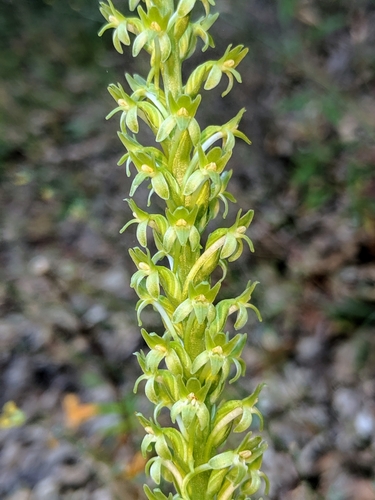
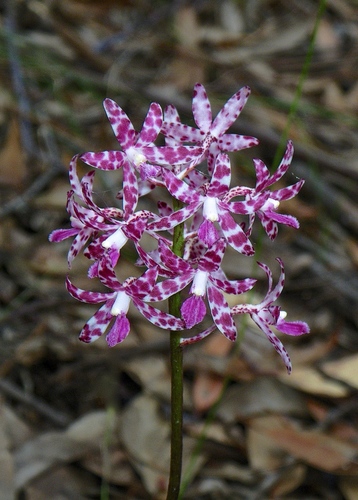
Dipodium variegatum M.A.Clem. & D.L.Jones is a leafless, mycoheterotrophic orchid. For most of the year, it remains dormant with no above-ground growth. Its tubers produce fleshy roots, and form shoots made up of leaf-like, sharply pointed overlapping bracts. These bracts sometimes protrude above ground, and inflorescences emerge from the shoots. Flowering takes place between December and February. The unbranched flowering stem grows 15–60 cm (6–20 in) tall, and bears between 2 and 50 flowers. The blossoms are fleshy, and range in color from cream to light pink, with maroon blotches. Sepals and petals measure 11–15 mm (0.43–0.59 in) long, 3–5 mm (0.12–0.20 in) wide, and are slightly reflexed. The labellum is 6–15 mm (0.2–0.6 in) long, and colored mauve to maroon. Near the base of the labellum are two diverging, linear, hairy keels, and a band of mauve hairs around 1 mm (0.04 in) long runs along its midline. Ovaries are curved with a warty surface. Along with the pedicels, they are covered in prominent maroon spotting, and together measure 10–17 mm (0.39–0.67 in) long. A form with fully dark maroon sepals and petals is found in some parts of the species' distribution. Dipodium variegatum is similar to Dipodium roseum, but D. roseum has converging keels on the labellum, and lacks the dense patch of tangled hairs near the labellum tip that D. variegatum has. Among Australian Dipodium species, D. variegatum is the only one that has distinctly spotted ovaries, and sometimes spotted pedicels. This orchid occurs in eastern Queensland, ranging north to the Mount Windsor Tableland west of Daintree National Park, and in New South Wales, ranging west to Temora. In Victoria, it is only found in the far east. It grows in a wide variety of habitats, from heath to wet forests. Recovered DNA analysis shows that D. variegatum forms mycorrhizal associations with Russula solaris and R. occidentalis, which aligns with the observation that many genus members form relationships with fungi in the family Russulaceae. The orchid has been observed growing close to Eucalyptus species, and researchers think it shares a relationship with these trees through the mycorrhizal association. Like all species in the Dipodium genus, this orchid is pollinated by native bees and wasps. No leafless Dipodium species have been kept successfully in cultivation, because it is impossible to replicate their natural mycorrhizal fungal association in a horticultural setting.