About Diploglottis australis (G.Don) Radlk.
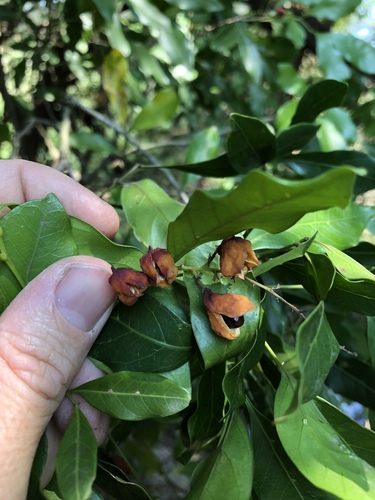
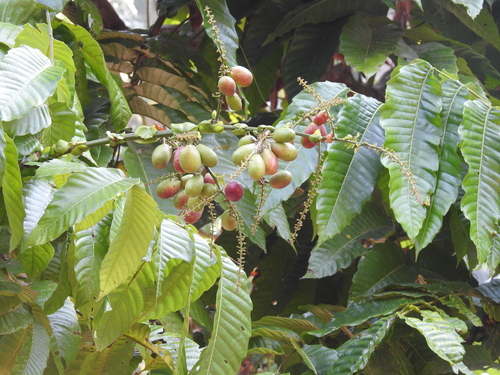
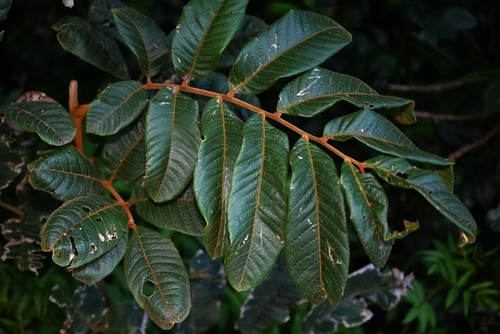
Diploglottis australis, commonly called native tamarind, is a large tree that reaches around 35 m (115 ft) tall in its natural habitat, and the base of its trunk may be fluted. New growth is densely covered in fine rusty-brown hairs. Its leaves are very large, growing up to 135 cm (53 in) long, and are pinnate, typically bearing 8 to 12 stiff leaflets. Leaflets are generally 15 to 30 cm (5.9 to 11.8 in) long and 5 to 10 cm (2.0 to 3.9 in) wide; they are dark green on their upper surface and lighter on the underside, oblong in overall shape, with blunt or rounded tips and slightly asymmetric bases. Each leaflet has between 20 and 30 lateral veins on either side of the midrib, and leaflet margins are entire, meaning they do not have teeth or lobes. Inflorescences develop in upper leaf axils, are heavily branched, and grow up to 50 cm (20 in) long. The numerous flowers are quite small, about 3 mm (0.12 in) in diameter, with four or five greenish sepals and white petals. Flowers are functionally either male or female, but both types are present on a single individual plant, making this species monoecious. Functionally male flowers have eight stamens arranged on one side of an undeveloped ovary, while functionally female flowers have a fully functional 3-locular ovary paired with sterile stamens called staminodes. The fruit is a yellow-orange, 2- or 3-lobed capsule around 3 cm (1.2 in) wide, lightly covered in pale rusty-colored hairs. Each developed lobe holds a single brown seed that is fully enclosed in a fleshy orange aril. Diploglottis australis grows in subtropical, warm temperate, and dry rainforests, on basaltic and rich alluvial soil. Its natural range extends from just north of Batemans Bay (~35.5° S) in New South Wales to near Maryborough (~25.5° S) in Queensland. Flowers typically appear from September to November, and fruit ripen between November and December. The fruit of this species is eaten by fruit bats and many bird species including fruit doves, pigeons, green catbirds, and satin bowerbirds, while brush turkeys scavenge fallen fruit on the ground. This tree is also a host plant for the larvae of two butterfly species: the pale green triangle (Graphium eurypylus) and the bright cornelian (Deudorix diovis). Known as native tamarind in cultivation, this tree makes an ideal park tree. It is widely cultivated in Australia for its distinctive attractive foliage, abundant colourful fruit, and rust-coloured furry new growth flushes. In cultivation, the tree usually only reaches about 10 m (33 ft) tall, compared to 35 m in forest habitats, because cultivated trees do not need to compete with surrounding trees. It is not well suited to locations with strong winds, which can damage its large leaflets. It can also be grown as an indoor plant. It can be propagated from fresh seed, which germinates easily. However, good quality seeds can be hard to obtain, as they are quickly eaten by fruit bats, birds, and ants, and may also be attacked by butterfly larvae. The orange arils have a refreshing acidic flavour; they can be eaten raw, and have been used to make jams, jellies, sauces, chutneys, and cordials. Its timber can be used for indoor construction and woodworking.