About Diplacus puniceus Nutt.
Growth Form
Diplacus puniceus Nutt. is a perennial, hairless evergreen subshrub or shrub.
Mature Size
On average, mature plants reach 24 inches (60 cm) in height and 36 inches (90 cm) in width.
Leaf Shape
Its leaves are typically linear-lanceolate in shape, with mostly smooth margins and pointed tips.
Leaf Characteristics
Leaf edges are tightly rolled under, and the uniformly green leaves are hairless like the rest of the plant.
Flower Production
Each leaf node produces between two and four flowers.
Flower Morphometrics
Flower stalks (pedicels) measure 9 to 22 mm long, the calyx is 19 to 27 mm in size, and the throat of the corolla tube measures 27 to 35 mm long.
Corolla Traits
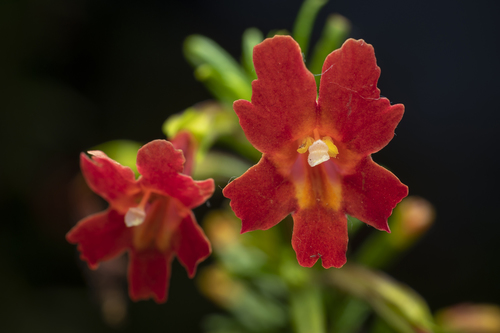
The corolla is slightly curved downward, and ranges in color from dark orange to red.
Flowering Period
This species flowers from March to June.
General Distribution and Habitat
The plant is distributed across Southern California, where it grows on granite outcrops, in chaparral openings, and in disturbed areas at elevations between 100 and 700 meters.
California Range Specifics
It is most abundant in the coastal regions of San Diego County, Orange County, and Riverside County.
Baja California Range
It also grows along the Pacific Coast of Baja California, ranging from the area around Tijuana south to El Rosario.