About Diplacus douglasii (Benth.) G.L.Nesom
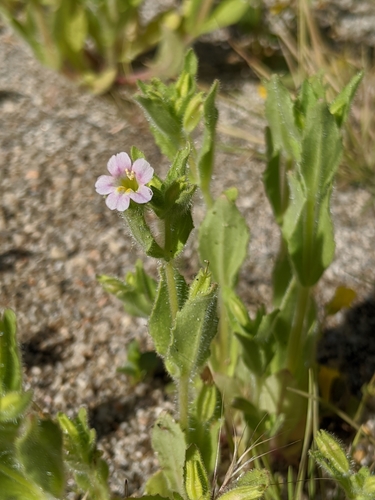
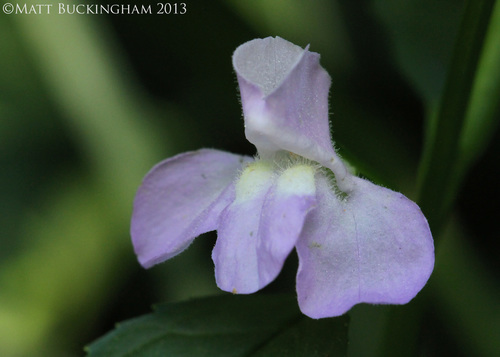
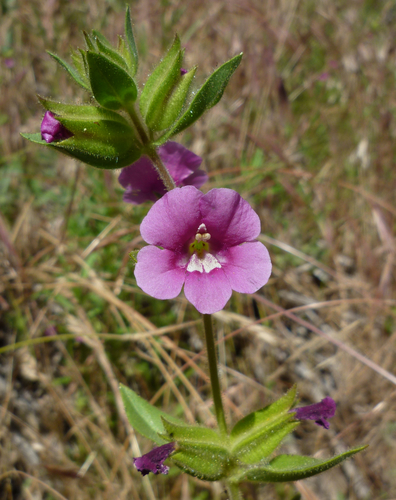
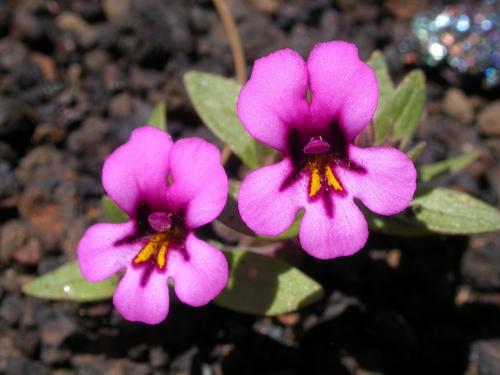
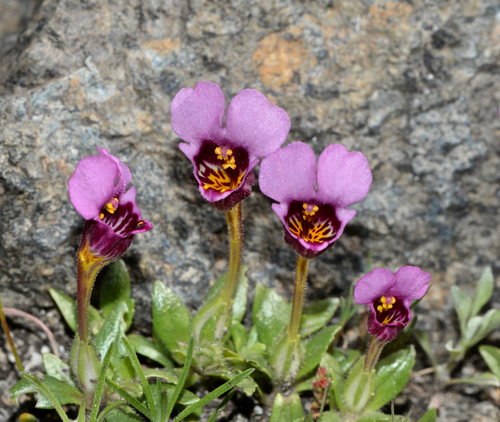
This description of Diplacus douglasii is taken from the second edition of the Jepson Manual: Vascular Plants of California. Diplacus douglasii is a very small annual herb that produces a magenta flower. Plants grow from 0.3 to 4 centimeters tall. Like other monkeyflowers, its flowers are bisexual and bilaterally symmetrical, with fused petals that form a tube-throat. The throat has gold and purple stripes that create bold mottling. The tube and upper lips of the flower are magenta, and the lower lobes are so reduced that they appear absent. Flowers can be either open, or cleistogamous meaning they stay closed and self-pollinate. The persistent flower sits on a 2 to 4 millimeter pedicel. The calyx is generally green and hairy, and ranges from 8 to 14 millimeters in size, with unequal lobes. The leaves are ovate to obovate blades, ranging from 5 to 28 millimeters in size. The upper surface of the leaves is shiny green and generally hairy. The seeds are hard, asymmetrically ovid, and range from 2.5 to 6.5 millimeters in size. Diplacus douglasii occurs at elevations between 45 and 1200 meters in the mountains and foothills of the Cascade and Sierra Nevada Ranges in California and Oregon. It can also be found in Southwestern Oregon, Central Western California, and the Warner Mountains of California. Classified as a serpentine indicator, it is most commonly found in serpentine soils, but can also grow on bare clay or granitic soils. As a hydrophyte, it generally grows along the upper banks of small creeks, and is classified as a facultative wetland species. It is equally likely to be found in wetland and non-wetland habitats, and also occurs in chaparral and foothill woodland plant communities. Diplacus douglasii flowers between February and April. When growing on serpentine soils, it has adaptations that let it survive conditions that most plants cannot tolerate. Serpentine soils are deficient in essential plant nutrients including nitrogen, calcium, phosphorus, potassium and sulfur. They also have high levels of magnesium and heavy metals including nickel, cobalt and chromium, which are toxic to most plants. Plant species that are commonly found growing alongside Diplacus douglasii are: Clematis ligusticifolia (creek clematis), Acer macrophyllum (bigleaf maple), Mimulus guttatus (yellow monkey flower), Salix exigua (narrowleaf willow), Rosa californica (California wild rose), Leymus triticoides (alkali rye), Artemisia douglasiana (California mugwort), Alnus rhombifolia (white alder), Umbellularia californica (California bay), Festuca rubra (red fescue), Rubus ursinus (California blackberry), Populus balsamifera ssp. trichocarpa (black cottonwood), Acer negundo var. californicum (California box elder), and Aquilegia formosa (columbine).