About Diphthera festiva Fabricius, 1775
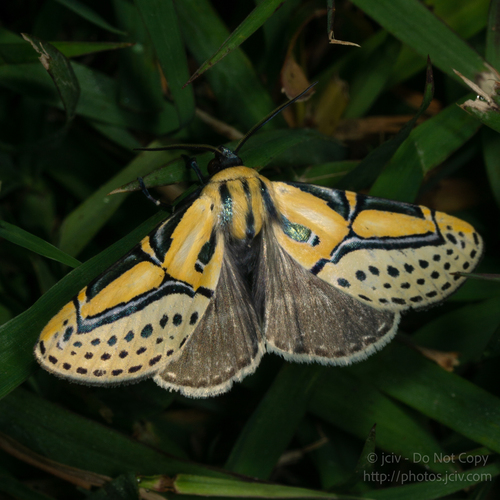
This species, commonly called the hieroglyphic moth, has the scientific name Diphthera festiva Fabricius, 1775. For identification, adult hieroglyphic moths have light yellow-orange forewings marked with distinct blue-black metallic lines, plus three rows of metallic dots running parallel to the outer wing margin. Their hindwings are black with a white fringe, and their pronotum is yellow-orange with three black stripes. The abdomen, legs, and thread-like (filiform) antennae are all black. Males and females have similar overall appearance, with one clear sexual difference: females have four tibial spurs on their hind legs, while males have only two. The species' pupae are dark brown to black, and measure approximately 1.7 centimeters long. Pupae are held in rounded cocoons constructed from silk and small pieces of plant material, which attach to trees or stems. These cocoons have a vertical exit slit, a trait characteristic of the moth family Nolidae. Hieroglyphic moth caterpillars have a red-orange head and red-orange anal plate, with a white body marked by black rings. Each body segment has three or four incomplete black rings that do not extend onto the cream-colored underside of the body. The caterpillars' spiracles appear as black dots, positioned between the black rings. Some caterpillars also have longitudinal black stripes running along the length of the body. Both the true legs and prolegs are black, and an orange spot sits above the prolegs on each side of the body. Fully grown caterpillars can reach up to 4.5 centimeters in length. Caterpillars feed in groups, and their prominent contrasting patterns may be aposematic, as supported by an observation recorded by Becker and Miller in 2002: when one adult male moth was tossed toward a gray kingbird (Tyrannus dominicensis Gmelin), the bird caught the moth mid-air, returned to its perch, attempted to swallow it, then spit the moth out and cleaned its beak against the branch. In 1980, Teran documented a parasitoid wasp from the family Chalcididae that was found on a wild D. festiva caterpillar in Venezuela. Hieroglyphic moth caterpillars feed mainly on plant species from the families Sterculiaceae, Fabaceae, and Malvaceae.