About Diospyros virginiana L.
Diospyros virginiana L., commonly called common persimmon or American persimmon, is generally a small to medium-sized tree. It usually reaches 30 to 80 feet (9 to 24 m) in height, and can grow up to 115 feet (35 m) west of the southern Mississippi. It has a short, slender trunk, and spreading, often pendulous branches that form a broad or narrow, round-topped canopy. Its roots are thick, fleshy, and stoloniferous, and the species can also grow in a shrubby form. It produces oval leaves with smooth, entire margins, and unisexual flowers borne on short stalks. Male flowers are numerous, with 16 stamens arranged in pairs. Female flowers are solitary, with vestigial stamens; they have a smooth ovary holding one ovule in each of its eight cells, topped by four styles that are hairy at the base. The fruit sits on a very short fruit stalk; it is subglobose, around an inch in diameter or slightly larger, with color ranging from orange-yellow to bluish. Its pulp is sweetish and astringent, and the fruit base is surrounded by persistent calyx lobes that grow larger as the fruit ripens. Unripe astringent fruit is somewhat unpalatable, but its flavor improves after exposure to frost, or when it becomes partially rotted (or "bletted", similar to a medlar).
The bark is dark brown or dark gray, deeply divided into scaly-surfaced plates. Young branchlets are slender and zigzag, with thick pith or a large pith cavity; they are initially light reddish brown and pubescent, change color from light brown to ashy gray, and finally become reddish brown, with bark cracked by longitudinal fissures. Bark is astringent and bitter. The heartwood of this species is true ebony, very dark; sapwood is yellowish white. The wood is heavy, hard, strong, and very close-grained, with a specific gravity of 0.7908, and a cubic foot weighs 49.28 lb (22.35 kg). Forestry texts note that a tree needs roughly a century of growth to produce commercially viable ebony. The wood's termite resistance comes from the component 7-methyljuglone. Winter buds are ovate and acute, one-eighth of an inch long, covered with thick reddish or purple scales that sometimes remain persistent at the base of branchlets.
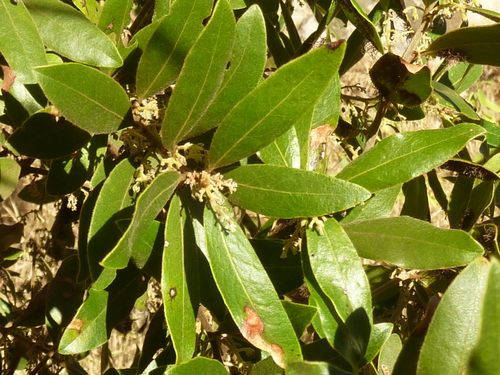
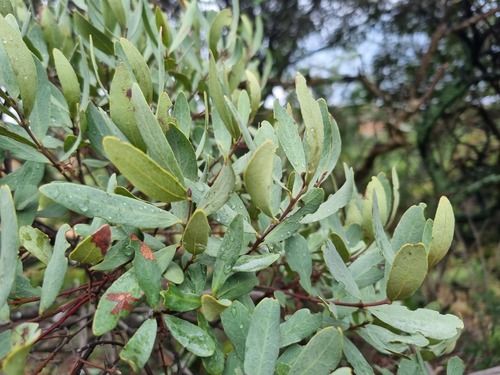
Leaves are alternate, simple, 4 to 6 inches (100 to 150 mm) long, oval, with a base that is narrowed, rounded, or cordate, entire margins, and an acute or acuminate tip. They emerge from the bud revolute, are thin, pale reddish green, downy with ciliate margins. When fully grown, leaves are thick, dark green and shining on the upper surface, pale and often pubescent on the lower surface. In autumn, leaves sometimes turn orange or scarlet, and sometimes fall without changing color. The midrib is broad and flat, primary veins are opposite and conspicuous. Petioles are stout, pubescent, and one-half to an inch in length.
Flowers bloom in May to June when leaves are half-grown; plants are mostly dioecious, rarely polygamous. Staminate flowers grow in 2 to 3-flowered cymes, with downy pedicels that bear two minute bracts. Pistillate flowers are solitary, usually growing on separate individual trees, with short, recurved pedicels that bear two bractlets. Fragrant flowers are pollinated by both insects and wind. The calyx is usually four-lobed, and grows larger beneath the fruit. The corolla is greenish yellow or creamy white, tubular, and four-lobed, with lobes that are imbricate in bud. Staminate flowers have 16 stamens inserted on the corolla, arranged in two rows; filaments are short, slender, and slightly hairy, anthers are oblong, introrse, two-celled, with cells opening longitudinally. Pistillate flowers have eight stamens with aborted anthers, and rarely these stamens are fully developed. The pistil has a superior, conical ovary that becomes eight-celled as it matures, four slender, spreading styles, and two-lobed stigmas.
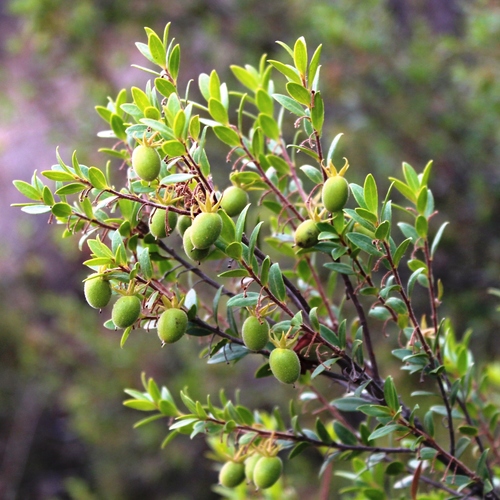
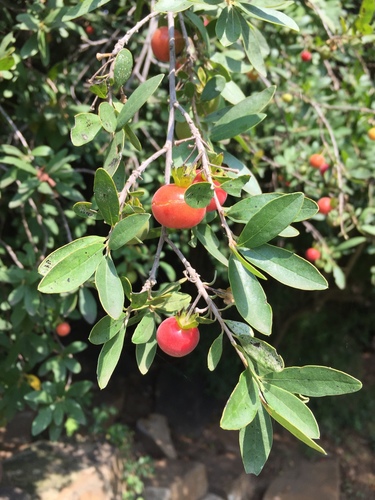
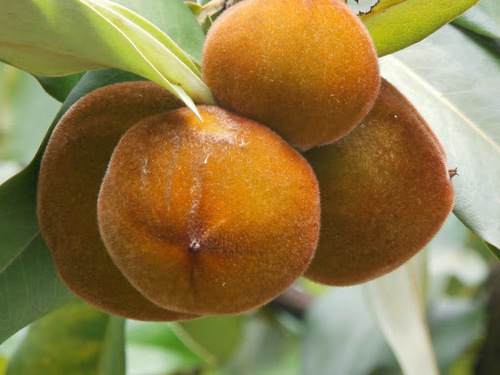
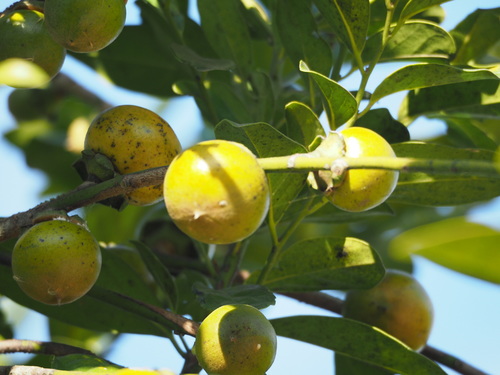
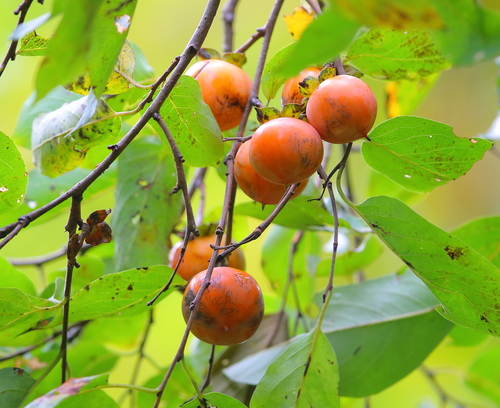
The fruit is a juicy berry containing 1 to 8 seeds, topped with style remnants, and seated in the enlarged calyx. It is depressed-globular, pale orange, often with red cheeks, and has a slight waxy bloom, turning yellowish brown after freezing. Flesh is astringent when green, sweet and luscious when fully ripe. Fruits can be round or oval, usually orange-yellow, sometimes bluish, with a diameter of 2 to 6 cm (3⁄4 to 2+1⁄4 in). Most cultivars are parthenocarpic, producing seedless fruit without pollination. Fruiting typically begins when the tree is around 6 years old.
This tree is very common in the South Atlantic and Gulf states of the United States, and reaches its largest size in the Mississippi River basin. Its native range is centered in the southern United States: by the early 20th century, it occurred along the Atlantic coast from Connecticut to Florida; west of the Allegheny Mountains, it is found in southern Ohio, southeastern Iowa, southern Missouri, Louisiana, eastern Kansas, and eastern Oklahoma, where it grows to its tallest size. Fossil remains of the species have been found in Miocene rocks of Greenland and Alaska, and in Cretaceous formations in Nebraska. Diospyros virginiana is considered an evolutionary anachronism, once consumed by one or more species of Pleistocene megafauna that inhabited North America until 10,000 years ago. A 2015 study found that passage of persimmon seeds through the gut of modern elephants increased seed germination rate and decreased time to sprouting, which supports the hypothesis that Pleistocene elephantids were the "ghost partners" that dispersed the species' seeds before North American elephantids went extinct.
Most American persimmon plants grow wild. Experimental research stations tested native persimmon varieties in the 1890s, but there has been limited interest in cultivating this native species. Newly planted persimmon trees take a relatively long time to bear fruit, and many other fruit tree types are easier to grow for commercial use. Wild varieties have many seeds, which makes processing fruit pulp for food and beverage production more difficult. Cultivation has produced varieties with fewer seeds, and some cultivated varieties have a very sweet flavor without the strong astringency found in wild persimmons. Harvested cultivated fruits have good shelf stability. The tree prefers light, sandy, well-drained soil, but will also grow in rich southern bottom lands. Fruit characteristics and quality vary widely among individual trees: fruit size ranges from that of a large cherry to a small apple. Some southern trees produce fruit that is delicious without frost exposure, while adjacent trees produce fruit that never becomes edible. It was introduced to cultivation in England before 1629, but rarely ripens fruit there. It can be easily grown from seed, and also propagated from stolons, which are often produced in large quantities. It is hardy in southern England and the Channel Islands. Persimmon trees rarely develop heartwood until they are nearly 100 years old.
Unripe fruit is extremely astringent, and is high in vitamin C. The fruit is eaten by birds, raccoons, skunks, white-tailed deer, semi-wild hogs, flying squirrels, and opossums. Ripe fruit may be eaten raw by humans, typically after bletting, or cooked or dried. Fruit pulp can be used to make pie, pudding, jam, molasses, and candy. An herbal tea can be made from the leaves, and roasted seeds can be used as a coffee substitute. The fruit can also be fermented with hops, cornmeal, or wheat bran to make a type of beer, or distilled into brandy. The heavy, strong, very close-grained wood is used in woodturning. The heartwood, which takes a century to develop, is true ebony, extremely close-grained and almost black, and is not harvested commercially. During the American Civil War, persimmon seeds were used as buttons in the South during periods of supply shortage.