About Dioon edule Lindl.
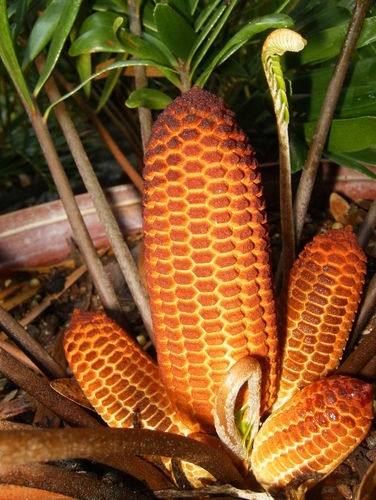
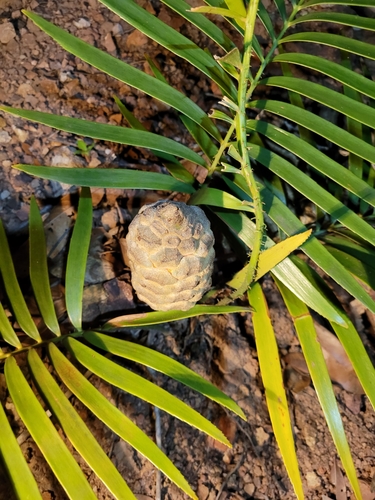
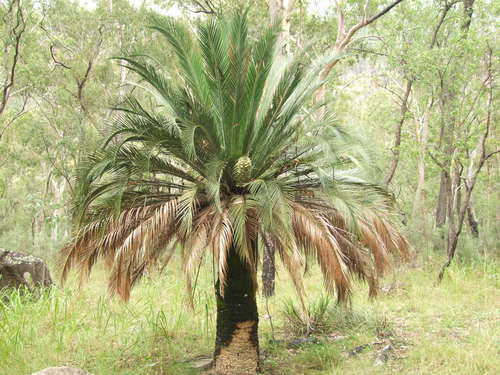
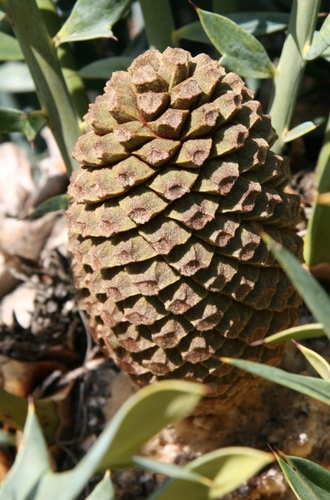
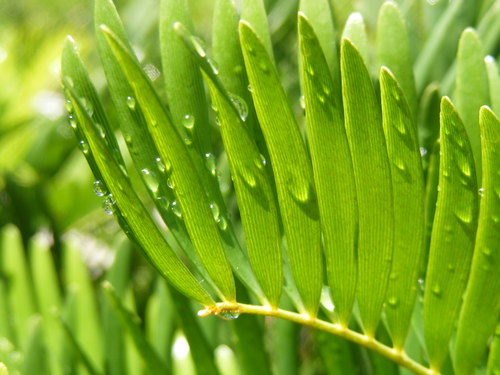
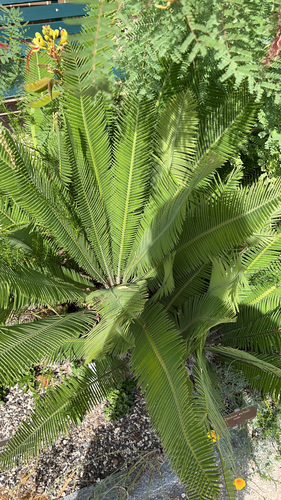
Dioon edule Lindl., commonly called chestnut dioon, also known as palma de la virgen, is a cycad native to Mexico. Cycads are among the oldest groups of seed plants, and pre-date the dinosaurs. This species belongs to the Zamiaceae family within the order Cycadales. The genus name "Dioon" translates to "two-egged", a reference to the plant's two ovules. Two subspecies of Dioon edule are recognized: Dioon edule subsp. angustifolium and the nominate Dioon edule subsp. edule; the nominate subspecies grows in moister conditions than the other. Dioon edule is endemic to the eastern coast of Mexico, and is distributed along the Sierra Madre Oriental from Veracruz to Nuevo Leon. It typically grows in tropical deciduous thorn forests and oak woodlands. It is most often found at altitudes between 500 and 1000 feet, growing in harsh sites with exposed, shallow soils. Most of the species' native range experiences very dry climates and frequent brush fires, which affect D. edule survival and distribution. Disturbances change the population dynamics of Dioon edule populations. Populations heavily dominated by adult plants experience minimal disturbance impact, compared to populations made up mostly of younger plants, because adult D. edule are able to survive harsh conditions. D. edule exhibits a Type III survivorship curve and clumped distribution patterns. It occurs most often on shallow, rocky soils, due to competition with faster-growing plant species for water, nutrients, and seed dispersal. In response to these harsh growing conditions, D. edule has developed selective advantages, including vigorous tap roots that provide anchorage and conduct water. Growing in hard-to-reach locations also makes it more difficult for rodents to access the plant and its seeds. In addition to competition, factors that cause D. edule's random, clumped distribution include predation, variations in temperature and precipitation, and seed dispersal patterns. Dioon edule is a slow-growing species, and high death rates among seedlings are particularly harmful to its populations. Seeds must survive harsh dry climates and frequent bushfires, while most mature, heavily armored plants can withstand these fires. Smaller seeds and juvenile plants rarely survive fires, but the release of nutrients and minerals from fire encourages female plants to develop cones the following season. Besides climate challenges, seeds must also avoid predation by rodents. This predation is unusual, because cycad seeds and foliage are poisonous to most mammals, but do not affect these rodent species. Young D. edule leaves are also eaten by larvae of the butterfly Eumaeus debora. Leaflet characteristics are a useful identifying feature for cycads, and this trait was not heavily studied when cycads were first described. Later research found that leaflet width correlates with the geographic range of D. edule subspecies: wider leaves, characteristic of Dioon edule subsp. edule, occur in the southern part of the range, while the narrower leaves of Dioon edule subsp. angustifolium are found further north. Genetic evidence indicates Dioon edule subsp. edule was once far more widespread than it is today; its range became fragmented, leading to genetic isolation. It is hypothesized that the narrower leaves of the northern subspecies are an adaptation to the less temperate, less humid environmental conditions found in northern areas. Dioon edule roots host endomycorrhizae, which increase the plant's absorption of nutrients and water. Symbiotic blue-green algae also grow in the species' coralloid (upward-growing) roots. These algae fix nitrogen to provide the plant with essential nutrients, in exchange for protection from the plant. Cycads as a group play important roles in the nitrogen budget of their ecosystems.