About Dionaea muscipula Ellis
Dionaea muscipula Ellis, commonly known as the Venus flytrap, is a small carnivorous plant.
Basal Structure
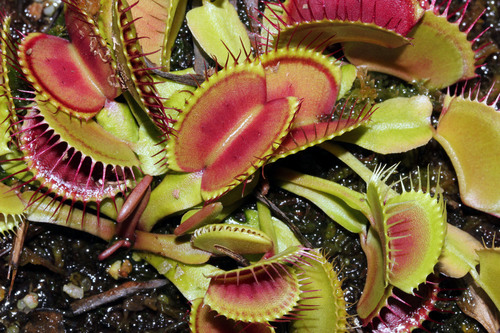
Its overall structure consists of a rosette of four to seven leaves growing from a short, bulb-like subterranean stem. Stems reach a maximum size of 3 to 10 centimeters, varying with the time of year; longer leaves with sturdy traps typically develop after flowering.
Colony Formation
Any Venus flytrap with more than seven leaves is actually a colony formed by rosettes that have divided underground.
Native Habitat Types
Venus flytraps grow in nitrogen- and phosphorus-poor environments including bogs, wet savannahs, and canebrakes. They are small, slow-growing plants that tolerate fire very well, and depend on periodic burning to suppress competing plant life.
Wild Population Threats
Fire suppression threatens the survival of wild Venus flytrap populations. They grow best in wet sandy and peaty soils.
Native Range
While they have been successfully transplanted and cultivated in many locations around the world, they are native only to the coastal bogs of North and South Carolina in the United States, specifically within a 100-kilometer (62-mile) radius of Wilmington, North Carolina; one native location is North Carolina's Green Swamp.
Introduced Populations
A naturalized population of Venus flytraps is also found in northern Florida, and an introduced population exists in western Washington.
Trap Evolution Rationale
The nutrient poverty of their native soil is the reason Venus flytraps evolved their elaborate trapping structures: captured insect prey provides the nitrogen needed for protein formation that their soil cannot supply.
Winter Dormancy Requirement
They tolerate mild winters, and require a period of winter dormancy to survive freezing temperatures and short daylight periods. Most professional carnivorous plant growers recommend a winter dormancy period; Venus flytraps grown without dormancy typically need more light, water, and food to remain healthy.
Light Requirements
Venus flytraps are full-sun plants, and are naturally found only in areas with less than 10% canopy cover. The habitats where they thrive are either too nutrient-poor for most noncarnivorous plants to survive, or frequently disturbed by fire that regularly clears vegetation and prevents a shady overstory from developing.
Associated Plant Species
Venus flytraps are found growing alongside herbaceous plants, grasses, sphagnum, and fire-dependent Arundinaria bamboos.
Fire Regime Needs
Regular fire disturbance is an important part of their habitat, and is required every 3 to 5 years in most locations for Dionaea muscipula to thrive. After a fire, Dionaea muscipula seeds germinate well in ash and sandy soil, and seedlings grow well in the open conditions that exist after fire.
Seed Germination Traits
The seeds germinate immediately with no required dormant period.
Current Natural Range
Dionaea muscipula occurs naturally only along the coastal plain of North and South Carolina in the United States, with all known current natural sites located within 90 km (56 mi) of Wilmington, North Carolina.
Historical Site Records
A 1958 survey of herbaria specimens and old historical documents recorded 259 historically documented sites for the species across 21 counties in North and South Carolina.
Extirpated Locations
As of 2019, the species is considered extirpated from the inland North Carolina counties of Moore, Robeson, and Lenoir, as well as the South Carolina coastal counties of Charleston and Georgetown.
Remaining Populations
Remaining existing populations are found in North Carolina's Beaufort, Craven, Pamlico, Carteret, Jones, Onslow, Duplin, Pender, New Hanover, Brunswick, Columbus, Bladen, Sampson, Cumberland, and Hoke counties, and in Horry County, South Carolina.
Seed Propagation
In cultivation, Venus flytraps can be grown from seed, which takes approximately four to five years for plants to reach maturity.
Clonal Propagation
More commonly, they are propagated through clonal division in spring or summer.
Tissue Culture Propagation
They can also be propagated in vitro via plant tissue culture. Most Venus flytraps sold in nurseries and garden centers are produced through tissue culture, as this is the most cost-effective method for large-scale propagation.
Cultivated Lifespan
When cultivated under proper conditions, Venus flytraps live 20 to 30 years regardless of the propagation method used.
Commercial Herbal Products
Venus flytrap extract is sold commercially as an herbal remedy, and is sometimes the main active ingredient of a patent medicine called "Carnivora".
Promoted Health Claims
These products are promoted in alternative medicine as a treatment for a range of human ailments including HIV, Crohn's disease, and skin cancer, according to the American Cancer Society.
Evidence for Claims
However, available scientific evidence does not support these health claims.