About Dinema polybulbon (Sw.) Lindl.
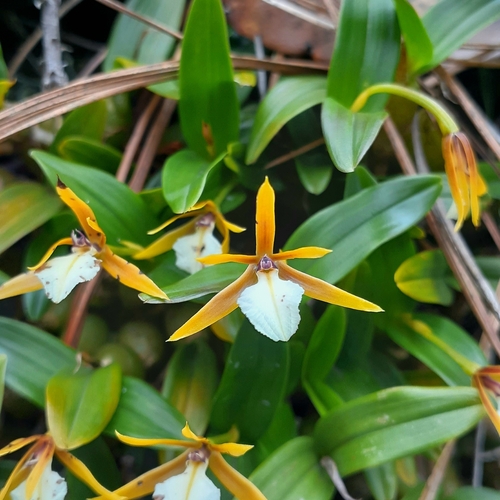
Dinema polybulbon (Sw.) Lindl. can grow as epiphytes or lithophytes. They have creeping rhizomes, with pseudobulbs spaced 1–1.5 cm apart along the rhizome. Each pseudobulb is 10 mm long, 6 mm wide, slightly compressed, yellowish-green, and grows two leaves at its apex. The leaves are 15 mm long and 8 mm wide, obtuse and emarginate, with a shiny green color. The inflorescence grows at the terminal end, and typically produces only one flower, rarely two. Flowers are 15 mm in diameter. Sepals are 9 mm long and 2 mm wide, and are shortly acuminate; petals are 9 mm long and 1.5 mm wide. Both sepals and petals are yellowish-brown. The lip is simple, 9 mm long, 6 mm wide, unguiculate, and adnate to the base of the column. The lip disc is dilated with undulated edges, and its thickened claw is 2 mm wide. The lip ranges in color from white to yellowish-white, and has a yellow claw. The column is 5 mm long, white with purple spots, and has two conspicuous extensions at its apex. The anther is terminal, and there are 4 pollinia. The ovary is 15 mm long and pedicellate. Fruits are ellipsoid capsules. This species is distributed across Mexico, Belize, El Salvador, Guatemala, Honduras, Nicaragua, Cuba and Jamaica. It is an uncommon species in its native habitat, where it grows in humid mixed forests at elevations between 1000 and 1400 meters. It blooms in November and bears fruit in August.