About Dimorphotheca ecklonis DC.
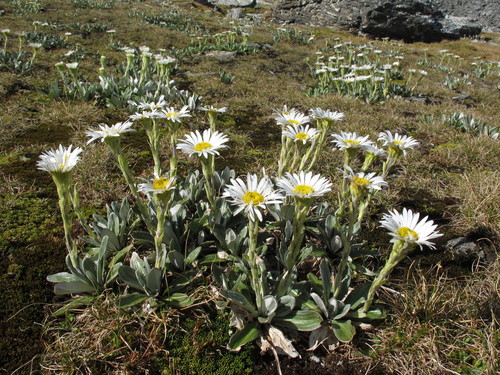
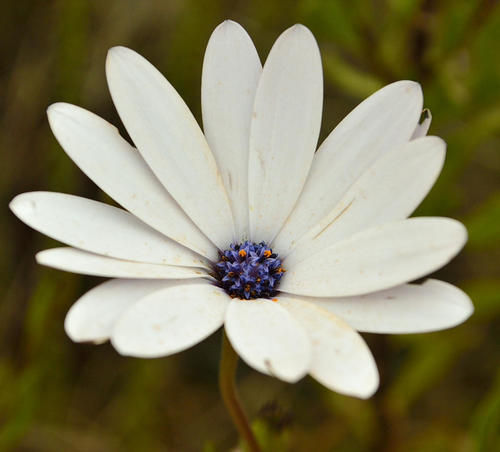
Dimorphotheca ecklonis DC. has many common names, including Cape Marguerite, African daisy, Van Staden's River daisy, Sundays River daisy, white daisy bush, blue-and-white daisy bush, star of the veldt, Kaapse magriet, jakkalsbos, Vanstadensrivier madeliefie, and Sondagsrivier madeliefie. This species is a perennial ornamental plant in the Asteraceae family, native to South Africa. It produces white ray florets with a dark blue central disc. The species is named for Christian Friedrich Ecklon, a Danish botanical collector who explored Cape flora in the early 1800s. It is considered an invasive species in parts of Australia, especially Victoria and Western Australia. In its native natural distribution, this plant grows at the base of cliffs or on steep hills. It is native to a small area of South Africa's Eastern Cape, around Uitenhage and Humansdorp, where it grows in wet grass and river beds at altitudes up to 300 meters (980 ft). It prefers subtropical biomes, and has been introduced to the Azores, California, Mauritius, New South Wales, Queensland, Réunion, Spain, Tunisia, Victoria, and Western Australia. It has also gained popularity as a cultivated plant in parts of Europe, such as Sicily, Italy. In cultivation, Dimorphotheca ecklonis can be grown as a perennial, but may be grown as an annual depending on the seasonal temperature variation of the local climate. Its peak flowering period occurs in spring, though some flowers will persist through summer. These plants grow quickly, and thrive best in full sun, in poor to moderately fertile, well-drained, sandy soil. It is widely grown as an ornamental for use in pots and garden bedding. In regions where it has become invasive, such as Australia, the white-flowered plants grow as groundcover. New plants can be grown from either seed or cuttings. Seed propagation should be done in spring, at cool temperatures around 18°C. The seeds germinate easily, and it is recommended to plant them 15 to 25 centimeters (5.9 to 9.8 in) apart. For propagation by cuttings, softwood cuttings are taken in late spring, and semi-ripe cuttings are taken in late summer.