About Diloba caeruleocephala (Linnaeus, 1758)
Scientific name: Diloba caeruleocephala (Linnaeus, 1758)
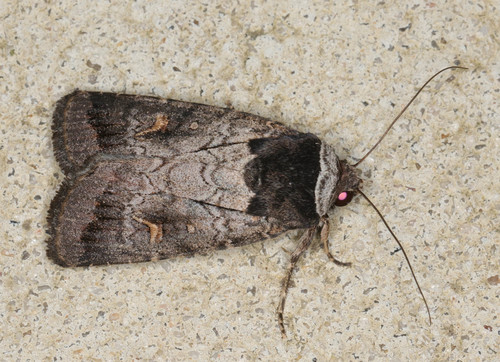
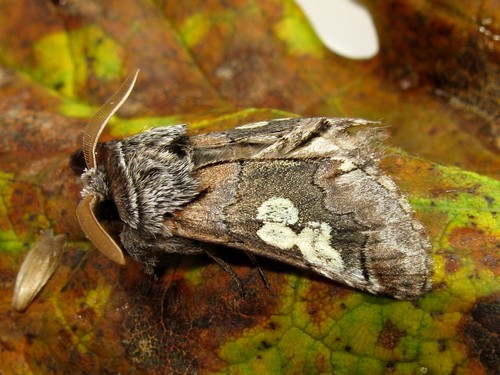
Description: This moth has a wingspan of 30–40 mm, with forewings measuring 15–19 mm in length. Two features are atypical for the Noctuidae family: the male has heavily combed antennae, and the female has a thick, woolly-hairy body. The forewings are grey or grey-brown with a purple sheen. Both the reniform and orbicular stigmata are shaped like a figure 8, enclosed in a yellowish white outline. The post median and subterminal lines are black, and there is a black tornal streak. The hindwing is ochreous white. The cilia are greyish brown, with a wedge-shaped black tornal mark.
The egg is hemispherical. It is initially white, turns yellowish as it develops, and becomes yellowish brown just before hatching. Fresh eggs have 13 to 16 wide, greenish longitudinal ribs.
Larvae are relatively thick at all growth stages, relatively short, and roundish in cross-section. First instar larvae are light to dark brown, with long bristles covering the entire upper surface of the body. Second instar larvae are black with yellow dorsal lines; their head is cream-colored with two black dorsal stripes. Third instar larvae are blue-grey with yellowish subdorsal bands; their head is grey-blue with two large black spots. The penultimate instar looks identical to the third instar. In the final instar, the caterpillar is greenish to bluish, with a series of yellow spots along its back and sides. In some specimens, these spots are so close together that they form three continuous longitudinal stripes. Black warts each holding a single bristle are distributed across the whole body. The final instar caterpillar's head is blue with two black dots, and fully grown adults reach up to 40 millimeters long.
The pupa is relatively short and thick. It is reddish brown with a faint blue tint. At the rear end, there are two lateral protrusions, each bearing four bristles.
Adults have one generation per year. In Belgium and The Netherlands, moths fly from late August to mid-November; in the UK, they fly from late September to mid-November. The larvae feed on a variety of deciduous trees and shrubs, with primary host plants including Sorbus, Prunus spinosa and Crataegus.
Distribution: Diloba caeruleocephala is found across most of Europe, excluding northern Scandinavia, the northern portion of the British Isles, and northern Russia. In the south, it occurs in North Africa, the Middle East (Lebanon, Israel, Jordan), Asia Minor, Iran and Kazakhstan. It is mostly absent from Portugal.